

Imagine a restaurant on a busy Friday night. The kitchen is moving fast. Dishes are leaving the counter. Waiters are crossing the room with plates in both hands. Tickets are being completed. From the outside, it looks productive. A lot of work is happening, and a lot of output is being produced.
But then you look closer. Some dishes are going to the wrong tables. Some customers are receiving meals they did not order. Some plates look beautiful, but the food is cold. Other dishes are correct and customers are happy, but every plate takes twenty steps, three people, two corrections, and a small argument near the oven.
That restaurant does not have one problem. It has three different questions tangled together.
It may be productive because it produces many dishes. It may be ineffective because some dishes do not satisfy the right customers. It may be inefficient because even the good results require too much waste, friction, coordination, and rework.
Software teams live inside the same confusion. We say a team is productive because it closes tickets, merges pull requests, ships features, fixes bugs, writes tests, creates dashboards, or deploys often. Sometimes that is true. Sometimes it is only motion wearing the costume of progress.
The hard part is not producing software. The hard part is producing the right software, in the right amount, with a cost of change the organization can keep carrying.
TL;DR
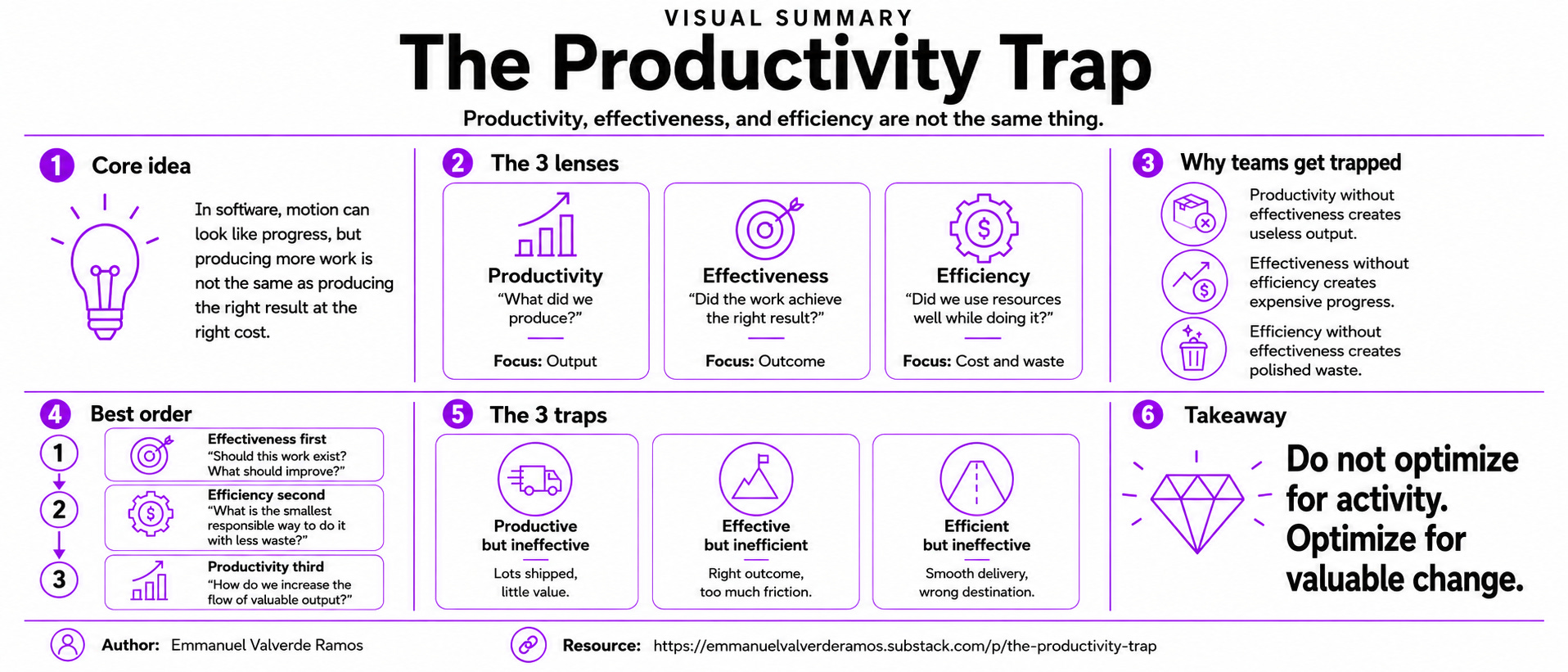
Productivity, effectiveness, and efficiency are related, but they are not interchangeable.
Productivity asks: what did we produce?
Effectiveness asks: did the work achieve the right result?
Efficiency asks: did we use our resources well while doing it?
In software and product development, confusing these three ideas creates bad decisions. Productivity without effectiveness creates useless output. Effectiveness without efficiency creates expensive progress. Efficiency without effectiveness creates polished waste.
The best teams do not start by asking how to produce more. They ask whether the work matters, how much waste exists in the way they work, and only then how to increase the flow of valuable output.
Index
Why this distinction matters in software
Productivity: what work was produced?
Effectiveness: did the work matter?
Efficiency: what did the work cost?
How the three ideas are related
Output, outcome, throughput, and the missing confusion
The first trap: productive but ineffective
The second trap: effective but inefficient
The third trap: efficient but ineffective
Examples from software engineering
How teams should use these words
Conclusions
References
Why this distinction matters in software
Software has a strange property: producing more of it is not automatically good. More code can mean more capability, but it can also mean more maintenance. More features can mean more customer value, but they can also mean more confusion. More tests can mean more confidence, but they can also mean more brittleness. More automation can mean faster feedback, but it can also mean more machinery to understand.
This is why the word “productivity” is dangerous when it is used alone. It sounds positive. It sounds objective. It sounds managerial. But without a clear object, it hides more than it explains.
A developer can look productive by pushing a lot of code. A team can look productive by closing many tickets. A department can look productive by shipping many initiatives. A company can look productive by filling a roadmap with completed items. None of that proves that the product improved, that customers received value, that risk went down, or that the system became easier to change.
Software work is not valuable because it exists. It is valuable when it changes something that matters.
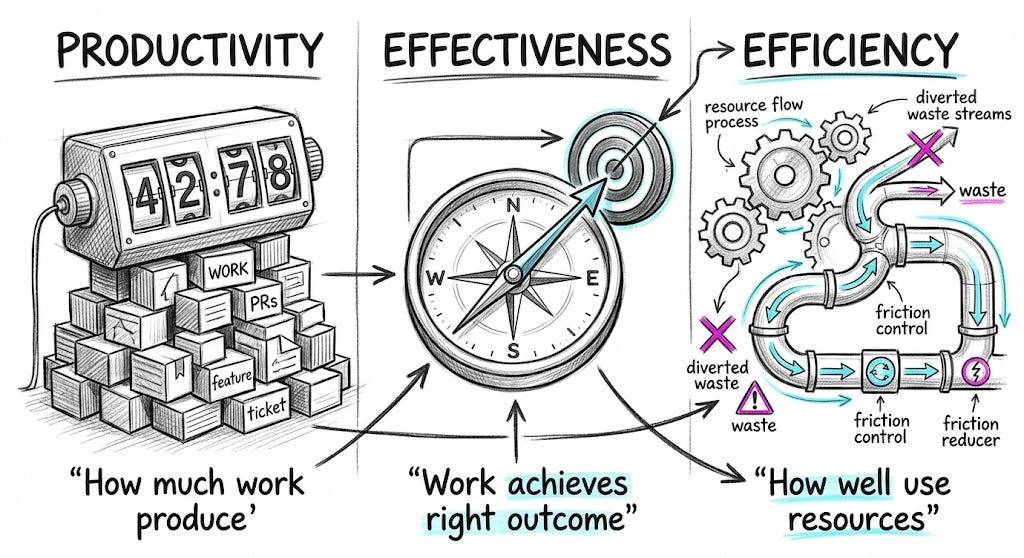
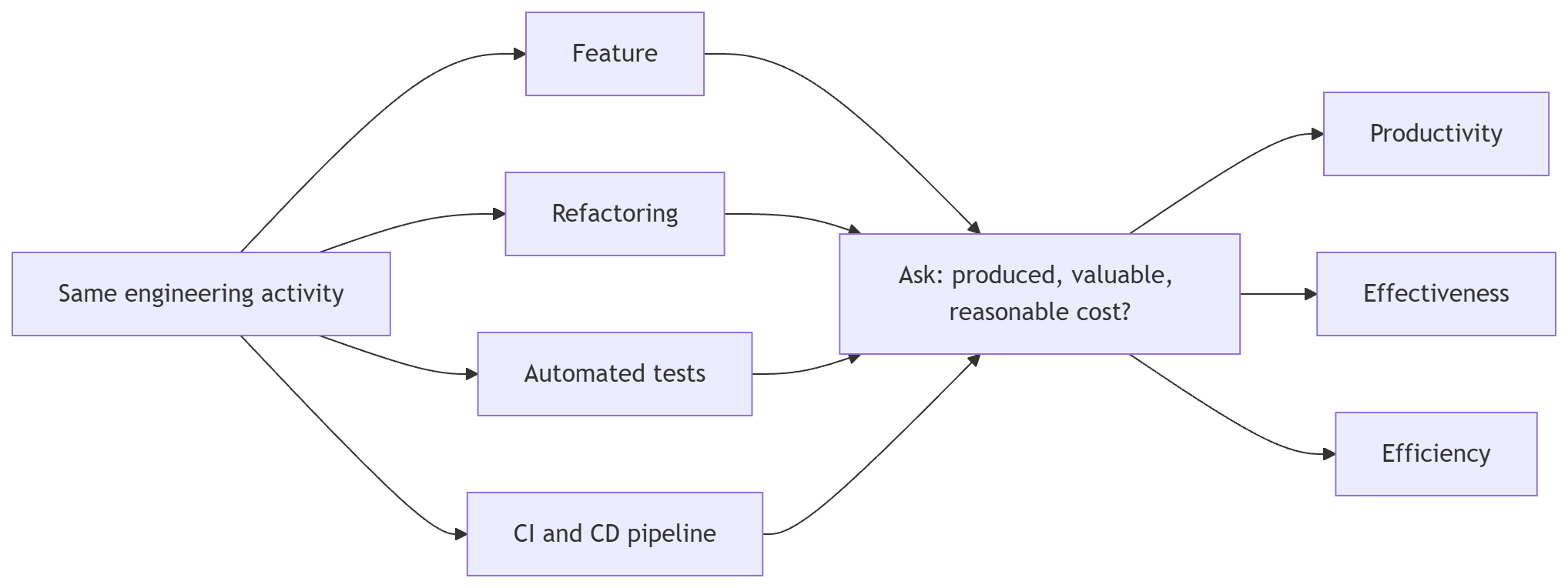
That is the center of the distinction. Productivity is about output. Effectiveness is about outcome. Efficiency is about the cost of getting there. A mature team needs all three, but each one answers a different question.

The diagram matters because the same piece of work can be judged three different ways. A feature can be productive because it was shipped, ineffective because it solved the wrong problem, and inefficient because it left behind unnecessary complexity. One activity. Three questions. Three different judgments.
Productivity: what work was produced?
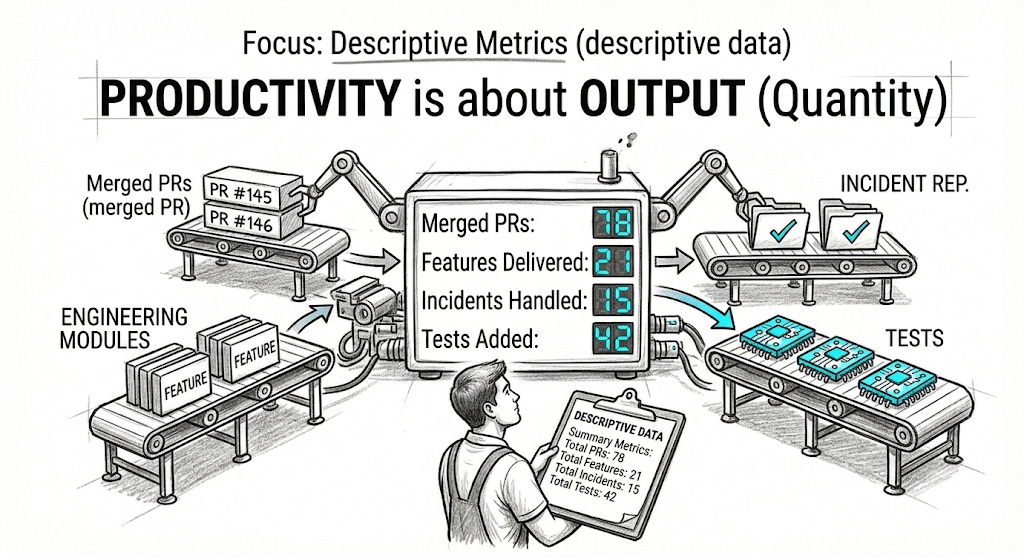
Productivity is the easiest of the three to see because it leaves visible traces. A pull request was merged. A ticket was closed. A feature was released. A bug was fixed. A test was added. A deployment happened. A migration was completed. A document was written.
There is nothing wrong with caring about this. A team that produces nothing is not secretly excellent. Software development must produce artifacts, decisions, learning, working behavior, and operational improvements. Output matters because without output there is no movement through the system.
The problem starts when productivity is treated as if it already included value. It does not.
A team can produce ten features that customers do not use. It can fix twenty bugs while ignoring the one problem that damages trust every week. It can merge forty pull requests that make the codebase harder to understand. It can add hundreds of tests that protect implementation details but fail to protect meaningful behavior.
Productivity tells us that work happened. It does not tell us whether the work was worth doing.
That is why “this team is productive” is an incomplete sentence. Productive at what? Producing code? Producing features? Producing learning? Producing business outcomes? Producing operational stability? Producing safer change? Producing options for the future?
The object matters. In software, different forms of output have different economic consequences. A line of code is not just a line of code. It is something that may need to be read, tested, reviewed, debugged, secured, deployed, observed, explained, migrated, and eventually removed.
Productivity can also be confused with the rate at which work is completed. A team might produce more work in the same period of time, and that may be useful. But even then, the same warning applies: producing more finished work does not prove that the finished work mattered.
This is the first aha moment: in software, output is not the end of work. Output is the beginning of responsibility.
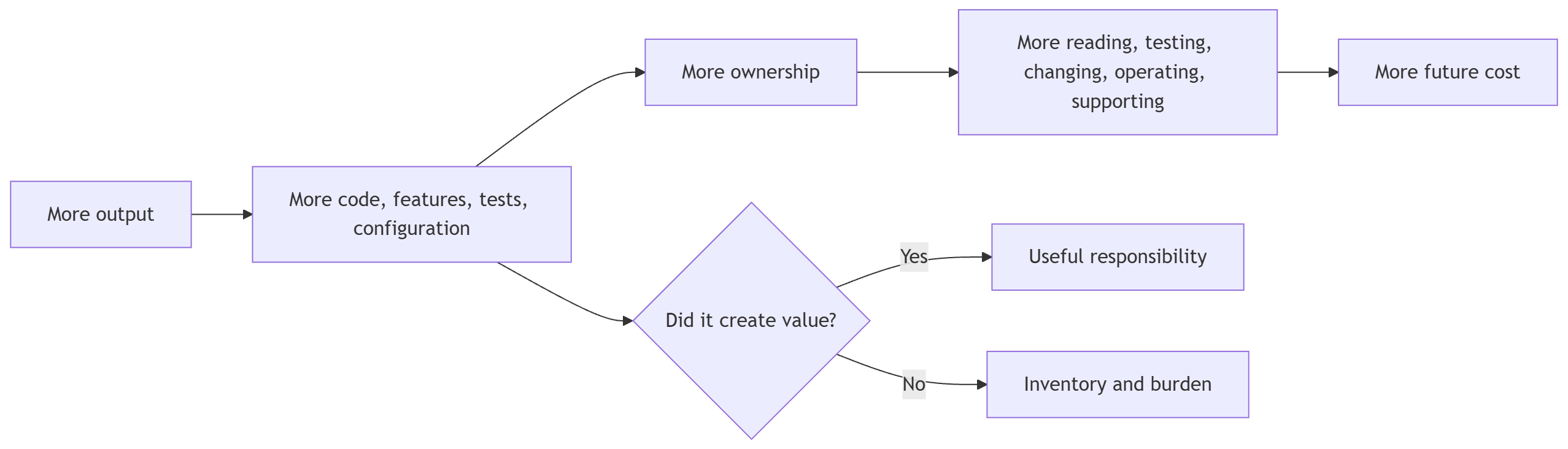
This is why output needs judgment. Useful output becomes an investment. Useless output becomes inventory. Both may look like productivity on a dashboard, but only one improves the system.
Effectiveness: did the work matter?
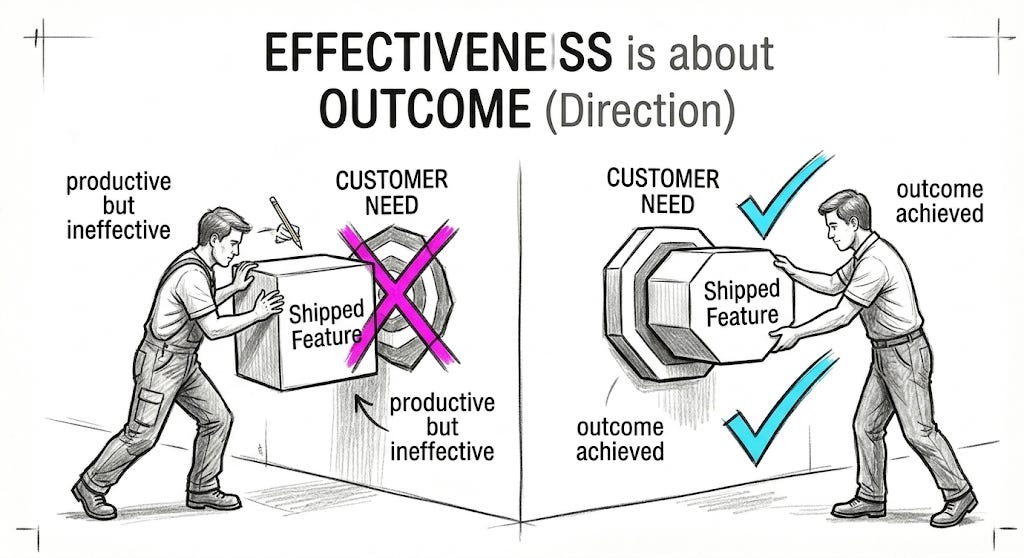
Effectiveness asks a harder question: did the work achieve the right result?
A team may ship a feature exactly as requested. The user interface works. The acceptance criteria pass. The release goes out on time. Everyone can honestly say the work was completed. But if users do not need it, if the business problem remains, or if the feature solves a symptom while leaving the real pain untouched, the team was productive but ineffective.
Effectiveness is not about whether effort was spent. It is about whether the work changed reality in the intended direction.
This matters deeply in product development. Product work is not the act of filling a backlog with ideas. It is not translating stakeholder requests into tickets. It is not making roadmaps look organized. Product work is economic judgment under uncertainty. It asks what deserves to exist, why now, for whom, at what cost, with what expected return, and with what opportunity cost.
A customer may ask for a dashboard, but the real need may be faster decision-making. A stakeholder may ask for export functionality, but the real need may be trust in the data. A support team may ask for more configuration, but the real need may be clearer rules and fewer exceptions. A sales team may ask for a custom workflow, but the real question may be whether this customer segment should shape the product at all.
Effectiveness forces teams to move from “we built the requested thing” to “we improved the situation that made the request appear.”
That shift is small in wording and huge in practice. The first version celebrates delivery. The second version asks whether delivery mattered.

The important point is not that requests are bad. Many requests contain useful information. The problem appears when a request becomes work without passing through a product judgment. Building what was asked is not the same as improving the situation that made the request appear.
Efficiency: what did the work cost?
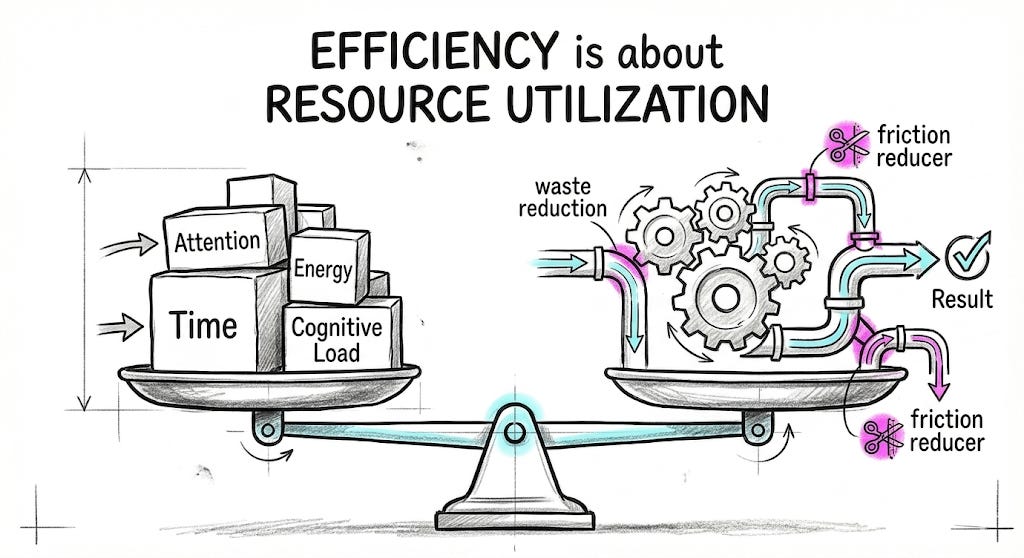
Efficiency asks a different question: did we use our resources well while producing the result?
In software, resources are not only time and money. They include attention, coordination, review capacity, test capacity, deployment capacity, operational capacity, emotional energy, and cognitive load. They also include future capacity, because every decision changes what the team can afford to do next.
A team can be effective and still inefficient. This is common in legacy systems. The team knows the right problem. The product opportunity is real. Customers care. The business case is sound. But every change is painful because the system is hard to understand, hard to test, hard to deploy, and hard to modify safely.
The direction is right, but the cost of movement is too high.
That cost matters because it compounds. If every valuable change requires heroic effort, the organization slowly becomes afraid of its own product. Good ideas become expensive. Small changes become political. Releases become stressful. Refactoring becomes hard to justify because everyone is already late. Testing becomes slower because the system was not designed for feedback. Eventually, the team still wants to improve the product, but the codebase charges a toll on every step.
Efficiency is not about squeezing people to do more with less. That is a shallow and often harmful reading. In a healthy engineering system, efficiency means reducing waste from the path of valuable work.
Waiting is waste. Rework is waste. Unclear requirements are waste. Slow feedback is waste. Fragile tests are waste. Long-lived branches are waste. Manual release rituals are waste when they could be safely automated. Relearning the same confusing module every month is waste. Creating work that another team must untangle later is waste.
Efficiency also does not mean keeping everyone fully utilized. A system can be so full that it stops moving. A road with every lane occupied is not necessarily efficient if no car can move. A team with every person overloaded is not necessarily productive if work cannot reach users.
That is the paradox: what looks efficient in a static snapshot can be destructive in a dynamic system. Full calendars, full queues, and full workloads may look responsible, but if they create waiting, task switching, congestion, and delayed delivery, they are not efficiency. They are gridlock.
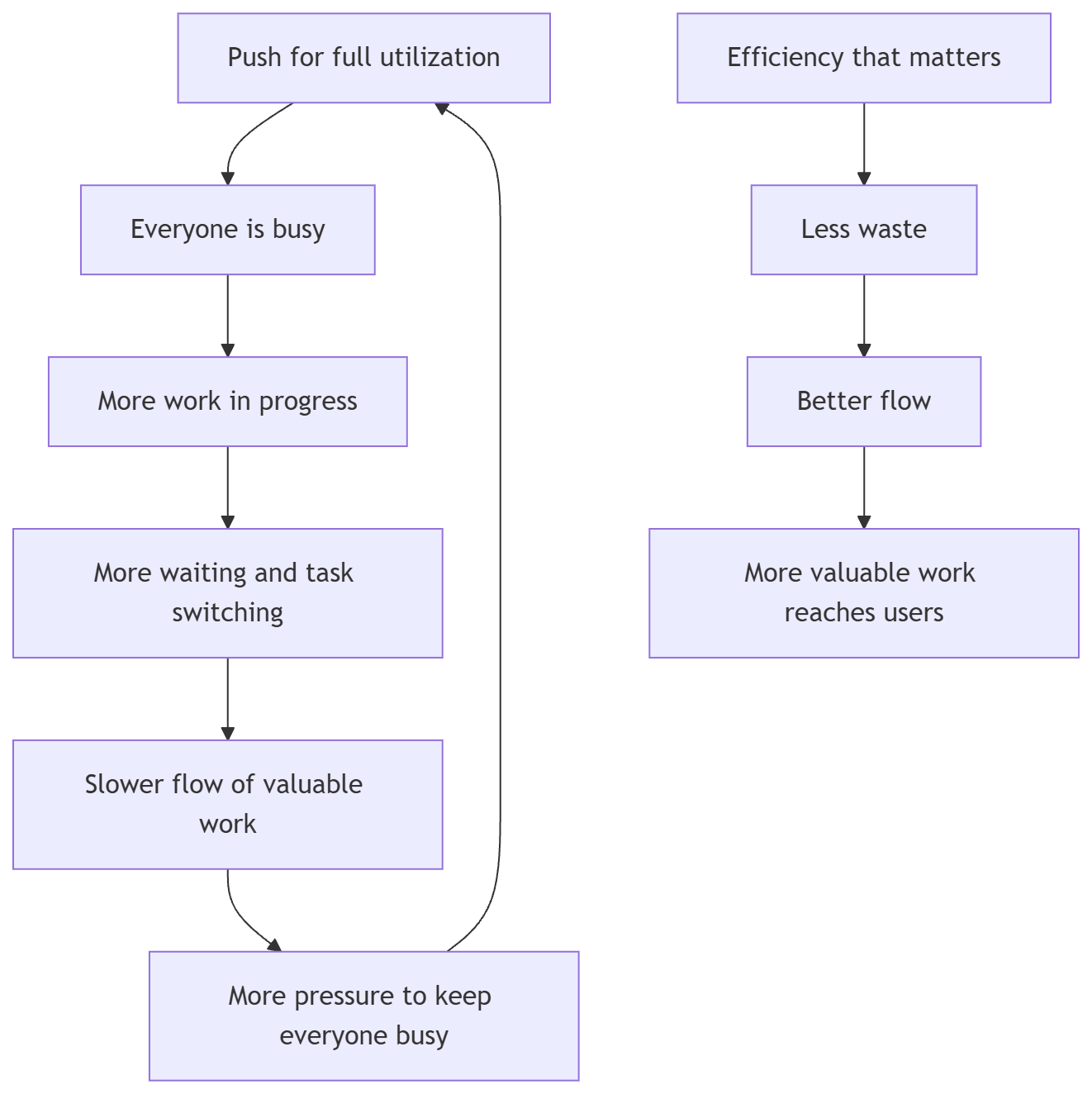
Efficiency is about protecting the organization’s ability to move. It is not a photograph of busy people. It is the health of the path from need to outcome.

How the three ideas are related
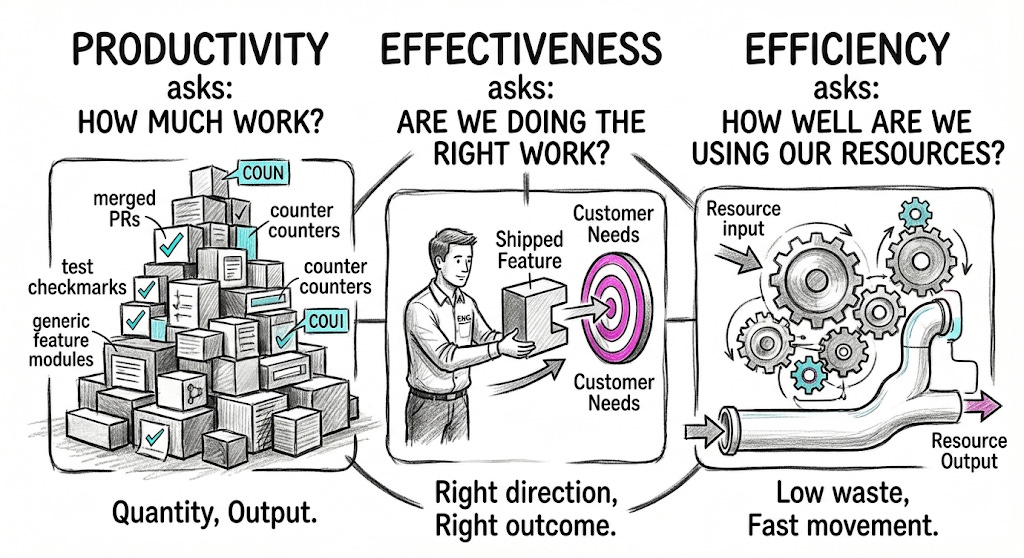
The three ideas are related because software work has direction, production, and cost.
Effectiveness protects direction. It asks whether the work should exist and whether it changes the right thing.
Efficiency protects capacity. It asks whether the way of working wastes time, attention, coordination, energy, or future changeability.
Productivity protects output. It asks whether the team is producing enough work once the direction is sound and the system is not drowning in waste.
The order matters. If a team starts with productivity, it may produce more of the wrong thing. If it starts with efficiency, it may optimize the delivery of low-value work. If it starts with effectiveness, it first asks whether the work deserves to consume capacity at all.
A strong operating sequence looks like this:
Effectiveness first: should we do this, and what result should change?
Efficiency second: what is the smallest responsible way to create or test that result with less waste?
Productivity third: once the work is valuable and the path is healthy, how do we increase the flow of aligned output?
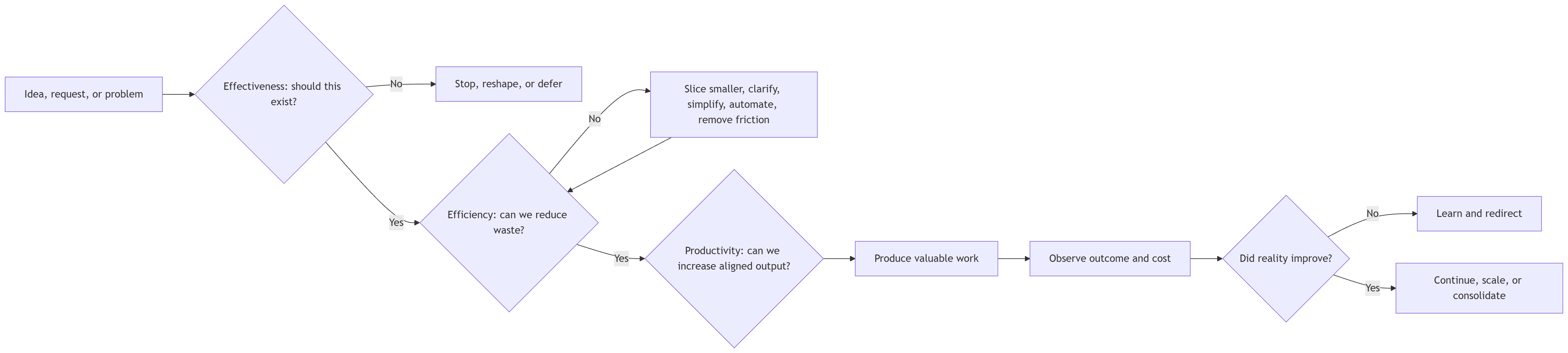
This sequence is not bureaucracy. It is economic discipline. If direction is wrong, more productivity scales the mistake. If the path is wasteful, more productivity burns capacity faster. If both direction and operating model are sound, productivity becomes powerful.
Output, outcome, throughput, and the missing confusion
There is a related distinction that helps sharpen the argument without replacing it: output, outcome, and throughput.
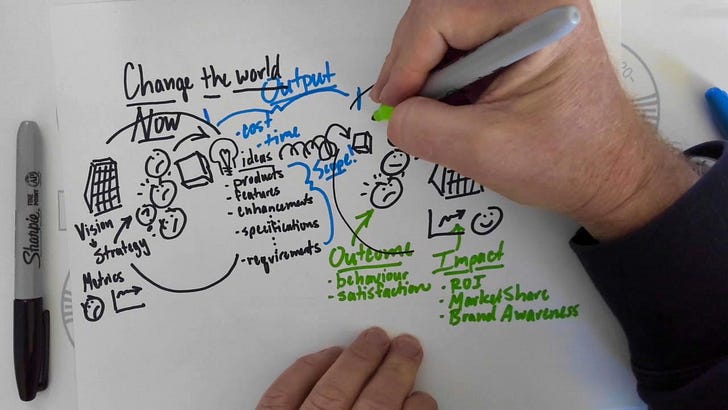
Output is what the team ships. Outcome is what changes because of that work. Throughput is how much finished work the system can complete over time. These ideas are not the same as productivity, effectiveness, and efficiency, but they help explain why teams confuse them.
Productivity often shows up as output or throughput. A team shipped five features. A team closed thirty work items. A team delivered more changes this month than last month. That may tell us something useful about production and flow, but it does not prove value.
Effectiveness is closer to outcome. It asks what changed because the work entered the world. Did users complete onboarding more easily? Did support pain decrease? Did a risky manual process become safer? Did the product become more useful? Did the business problem actually improve?
Efficiency is related to flow, but it is not the same thing as keeping everyone busy. A team can have high utilization and poor flow. Everyone may be working, switching, replying, reviewing, and attending meetings, while valuable work moves slowly through the system. In that case, the team is not efficient in the sense that matters. It is simply saturated.
This connection matters because teams often use a metric from one category as if it answered another category’s question. They treat shipped features as proof of value. They treat busy people as proof of efficiency. They treat faster delivery as proof of better product judgment.
None of those conclusions necessarily follows.
A better mapping is this:
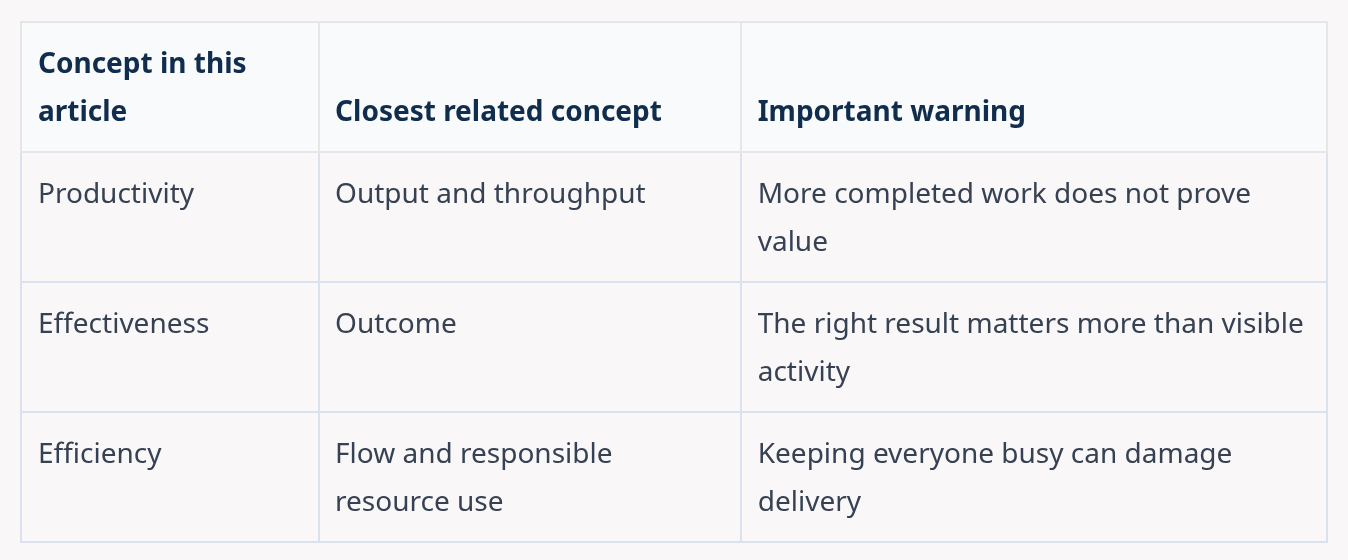
This keeps the focus where it belongs. The article is not about creating a bigger vocabulary. It is about separating questions that teams often collapse into one vague compliment: “we are productive.”
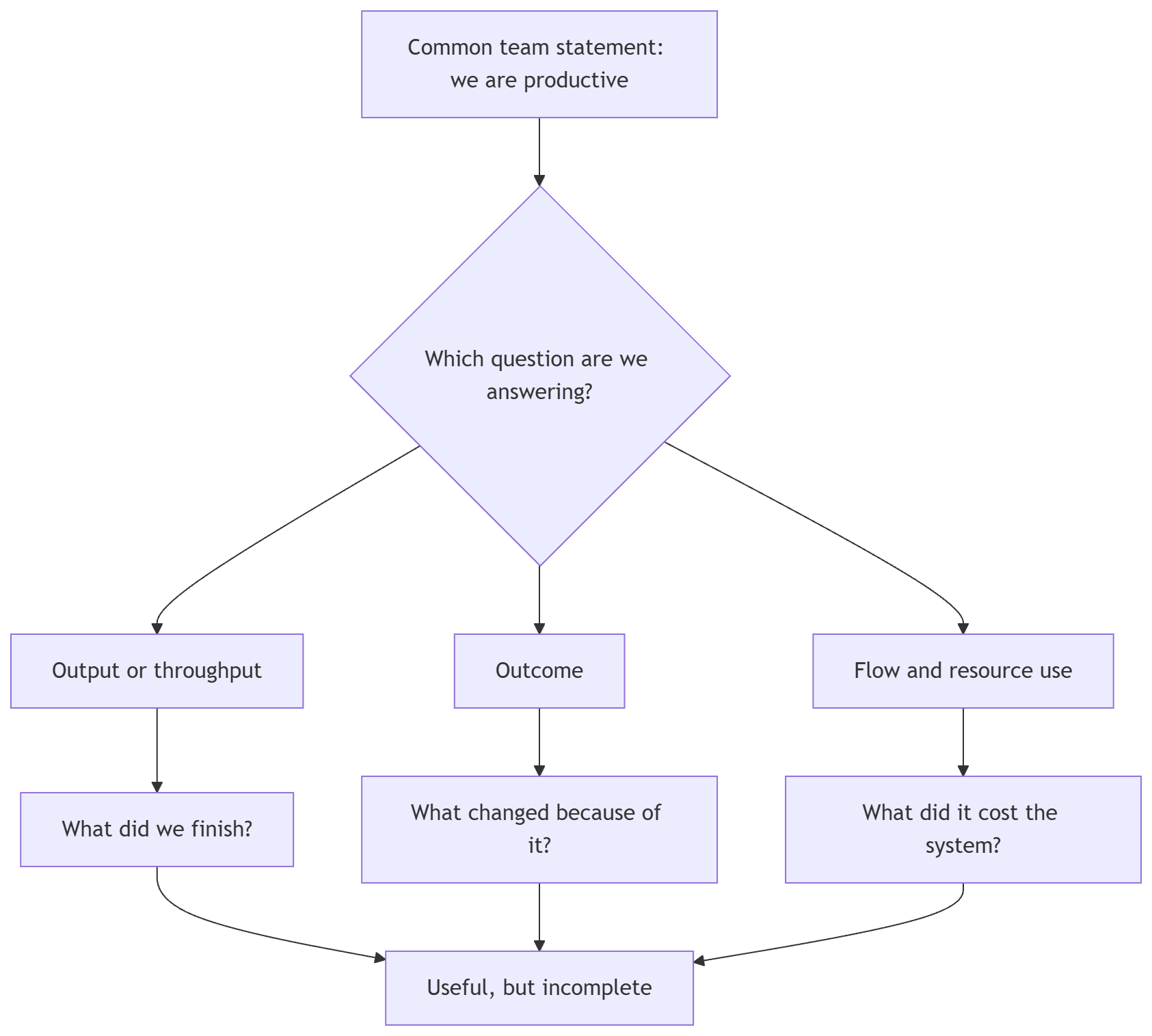
The phrase “we are productive” becomes useful only after the team clarifies which question it is answering. Without that clarification, it becomes a fog machine. It fills the room, but it does not help anyone see.
The order of things matters
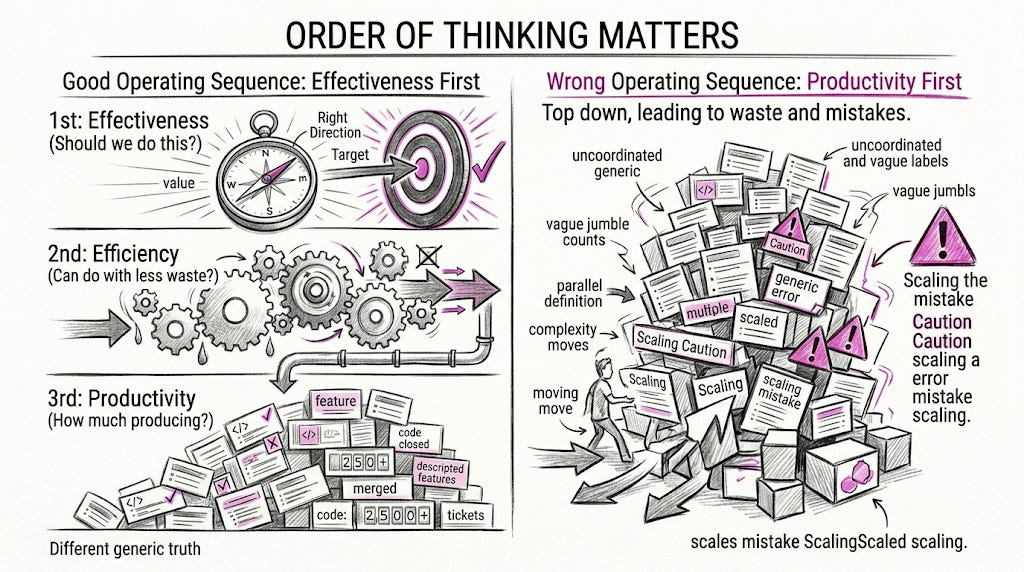
The order matters because productivity, effectiveness, and efficiency do not have the same responsibility in the system.
Effectiveness decides direction. Efficiency protects capacity. Productivity increases output. If we change the order, we change the kind of mistake the team is likely to scale.
Starting with productivity sounds tempting because output is visible. It gives managers something to count, teams something to report, and organizations something to celebrate. More tickets closed. More pull requests merged. More features shipped. More deployments completed. But if the work is not effective, increasing productivity only produces more of the wrong thing.
That is how teams create impressive movement without meaningful progress. They become faster at adding features nobody needs, fixing symptoms instead of causes, automating workflows that should not exist, and producing code the product will carry for years. Productivity is powerful only after direction is clear. Before that, it is an amplifier. It amplifies value when the work matters. It amplifies waste when the work does not.
Starting with efficiency has a different failure mode. It can make the organization feel mature because everything looks smoother. Meetings are shorter. Pipelines are faster. Boards are cleaner. Handoffs are reduced. People seem better coordinated. But if the team has not asked whether the work should exist, efficiency simply makes the wrong work cheaper to produce.
That is polished waste. The system becomes elegant, but not necessarily useful. The team removes friction from a path that may be leading to the wrong destination. A fast delivery system is valuable when product judgment is sound. When judgment is weak, speed becomes a way to move mistakes into production with less resistance.
Starting with effectiveness changes the conversation. It asks whether the work deserves to consume attention, time, money, and future maintenance. It forces the team to clarify the intended change before optimizing the work. What problem should improve? Who should benefit? What risk should go down? What behavior should be different? What would make this work unnecessary?
Once that direction is clear, efficiency becomes useful. The team can ask how to reduce waste while pursuing a meaningful outcome. Can we slice the work smaller? Can we learn before building the full solution? Can we reduce handoffs? Can we improve tests? Can we simplify the design? Can we remove friction from the path of valuable work?
Only then does productivity become healthy. At that point, producing more means producing more aligned work through a system that is not burning unnecessary capacity. The team is no longer trying to maximize activity. It is trying to increase the flow of valuable change.
The wrong order creates three predictable failures:
Productivity first: the team produces more before knowing whether the work matters.
Efficiency first: the team removes waste from a path that may still point in the wrong direction.
Effectiveness first: the team protects direction before improving the way it moves.
That does not mean productivity and efficiency are secondary in importance. It means they depend on context. Efficiency without effectiveness lacks judgment. Productivity without effectiveness lacks purpose. But effectiveness without productivity and efficiency can remain only a good intention.
The strongest order is not philosophical. It is practical:
First, ask if the work should exist.
Then, ask how to do it with less waste.
Finally, ask how to produce more of that valuable work.
Changing the order does not merely change the conversation. It changes what the system learns to reward. If the organization rewards productivity first, people learn to produce visible work. If it rewards efficiency first, people learn to optimize the process. If it rewards effectiveness first, people learn to care about whether reality improved.
That is why the order matters. The first question frames the system. The second question shapes the cost. The third question scales the result.
The first trap: productive but ineffective
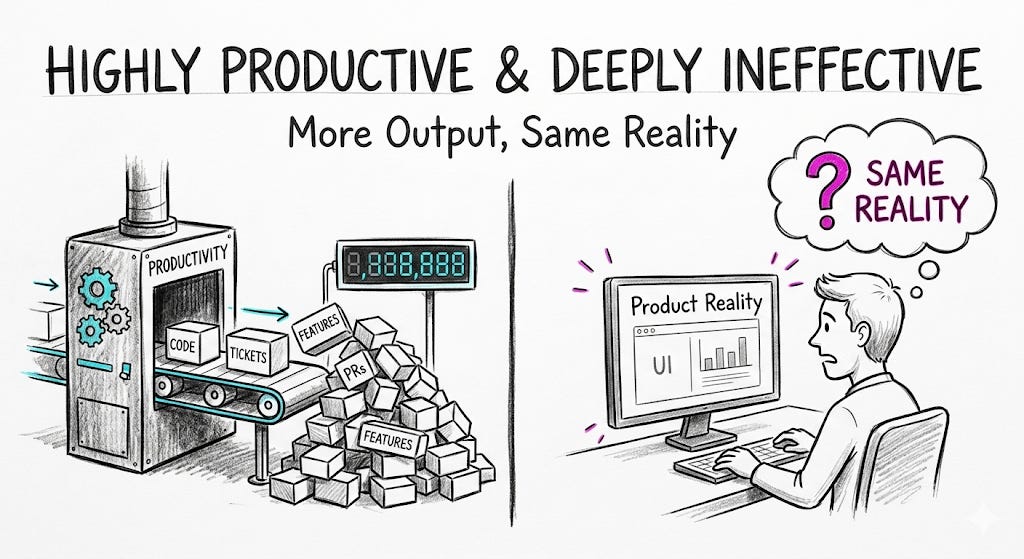
The first trap is the most visible in software organizations. A team produces a lot of work, but the product does not get better.
The roadmap moves. The sprint board clears. Pull requests are merged. Demos happen. Release notes are written. Everyone can point to output. But customers do not change behavior. Support pain remains. Revenue does not move. The onboarding problem survives. The operational problem returns next week. The strategic risk stays untouched.
This is productive but ineffective.
It often happens when teams confuse stakeholder demand with validated need. Someone important asks for something. The request enters the backlog. The team breaks it into tickets. The tickets become work. The work becomes output. The output becomes a release. But nobody asks whether the original request was the best way to improve the situation.
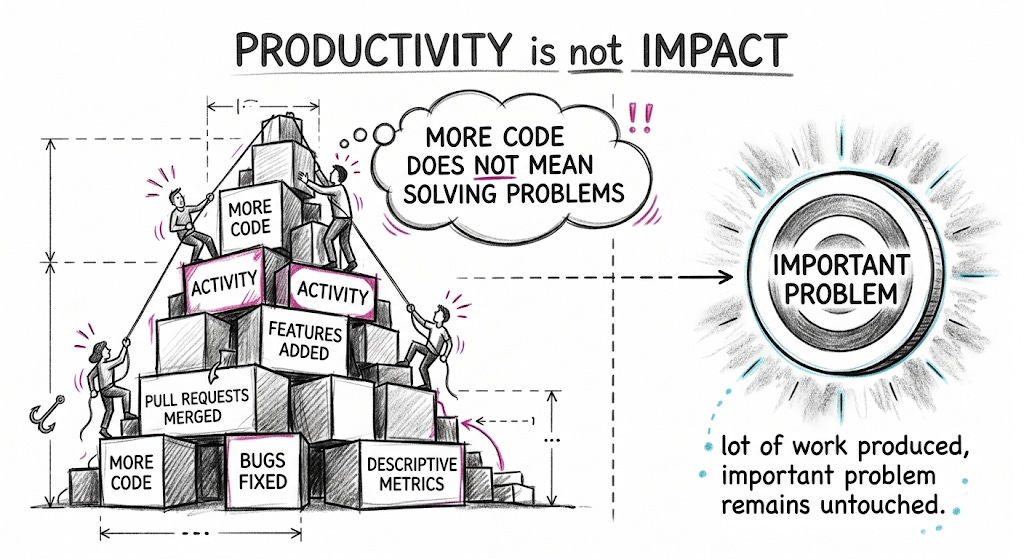
The danger is that this trap feels responsible. Everyone is busy. Everyone is doing their part. Nobody is obviously negligent. The machine is working. The problem is that the machine is pointed at the wrong target.
In software economics, this creates inventory. Not only unfinished work, but owned work. Code that must be maintained. Features that must be supported. Configuration that must be understood. Edge cases that must be tested. Documentation that must be updated. User expectations that must be honored.
The team produced work. The system inherited responsibility.
The second trap: effective but inefficient
The second trap is more subtle because it produces real value. The team works on the right thing. Customers benefit. The business improves. The product moves in a good direction. But every improvement costs too much.
This is effective but inefficient.
You see it when a small feature requires touching seven services, coordinating three teams, manually testing ten flows, waiting days for review, and holding your breath during release. You see it when everyone agrees on the right product decision, but the codebase punishes the team for trying to implement it. You see it when the team can still deliver, but only through stress, memory, heroics, and informal knowledge.
This trap often hides behind success. Since the outcome is good, the organization underestimates the damage done by the path. The feature worked, so the process is considered acceptable. The customer is happy, so the technical pain is postponed. The release succeeded, so the release anxiety is normalized.
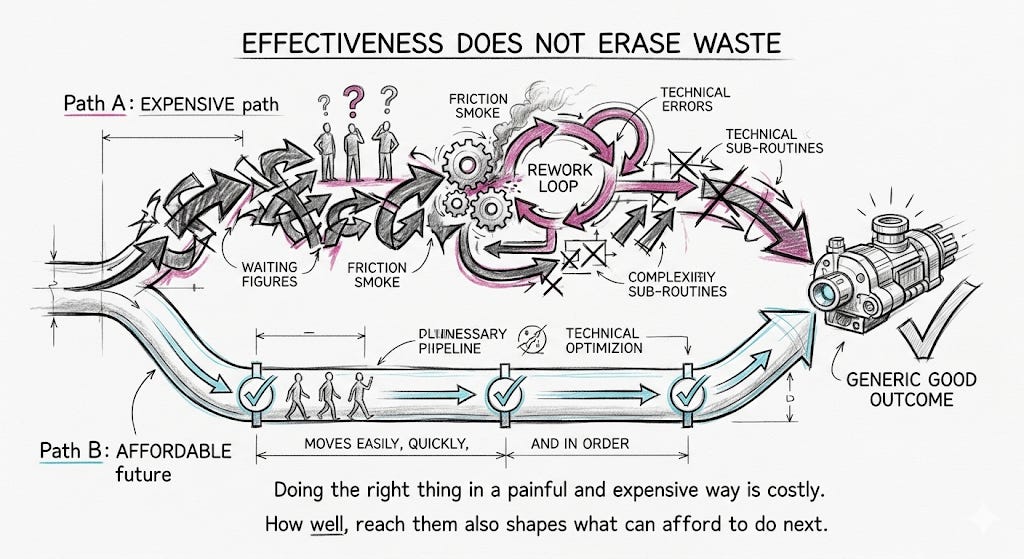
But the way we produce value shapes the value we can afford to produce next.
If every useful change leaves behind more coupling, more fragile tests, more operational burden, and more cognitive load, the team is not only delivering. It is borrowing against future capacity. Eventually, the organization stops asking what is valuable and starts asking what is survivable.
That is a dangerous moment. It means the cost of change has started to dominate product judgment.
The third trap: efficient but ineffective
The third trap is especially attractive in modern software organizations because it looks clean.
The team has short meetings. The pipeline is fast. The tickets are clear. The dashboards are polished. The ceremonies are optimized. Handoffs are reduced. The delivery process looks smooth. Everything moves.
But the product still does not improve.
This is efficient but ineffective.
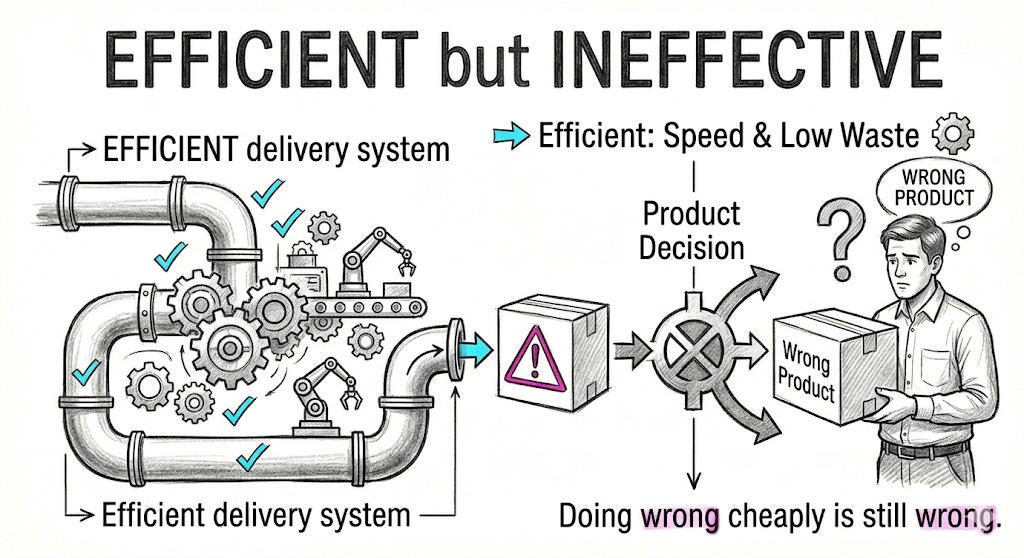
Efficiency is not wisdom. A very efficient system can still produce the wrong thing. A perfect factory producing unwanted goods is not a good factory. A software team that delivers the wrong product with low friction is still wasting capacity.
This trap appears when organizations become better at delivery than discovery. They improve execution without improving judgment. They automate the path from idea to production, but they do not improve the quality of the ideas entering the path.
This is how teams create polished waste. The work is well-shaped, well-tracked, well-tested, well-deployed, and well-presented. It is just not worth much.
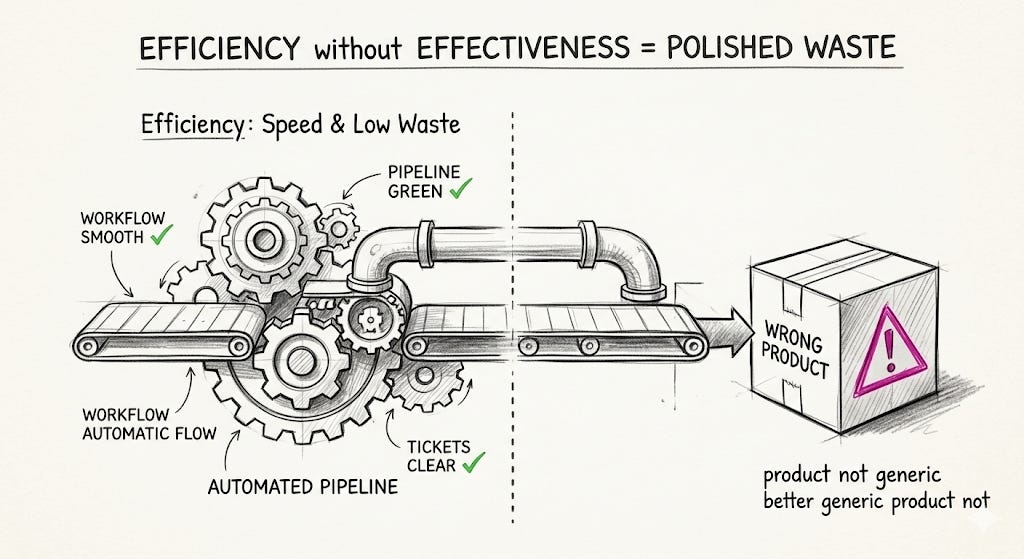
A fast pipeline does not fix a weak product decision. A clean backlog does not prove the work matters. A smooth process does not compensate for a bad bet.
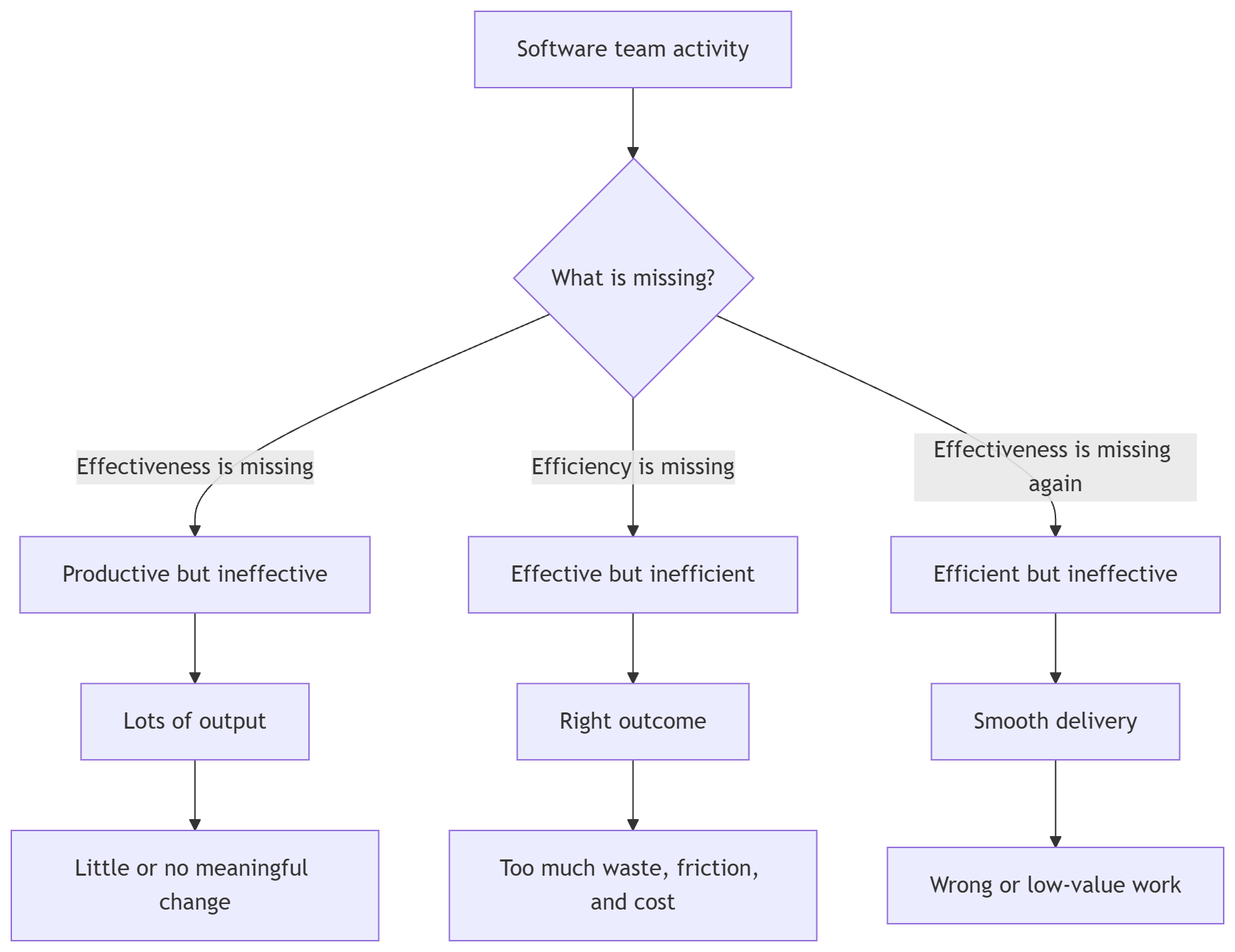
These three traps are useful because they stop the conversation from becoming moral. The question is not whether a team is good or bad. The question is which kind of failure is present, and which question the team has avoided.
Examples from software engineering
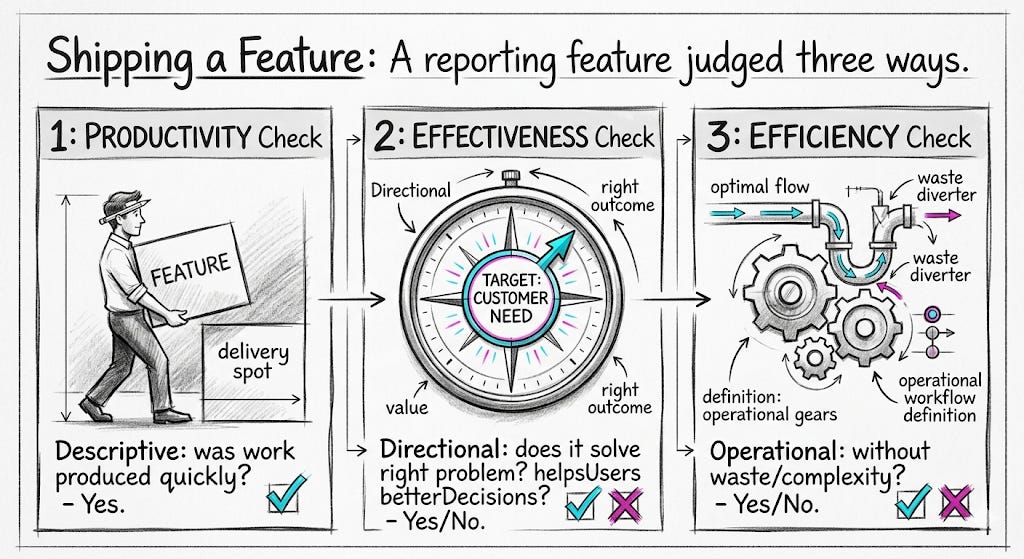
A feature can be judged through all three lenses. Suppose a team delivers a new reporting screen. Productivity asks whether the screen was built and released. Effectiveness asks whether users make better decisions because of it. Efficiency asks whether the team delivered it without unnecessary complexity, rework, or future maintenance burden.
A bug fix works the same way. Productivity asks whether the bug was fixed. Effectiveness asks whether the user pain disappeared or whether the team only patched a symptom. Efficiency asks whether the diagnosis, test coverage, review, and release path were proportional to the risk and impact of the problem.
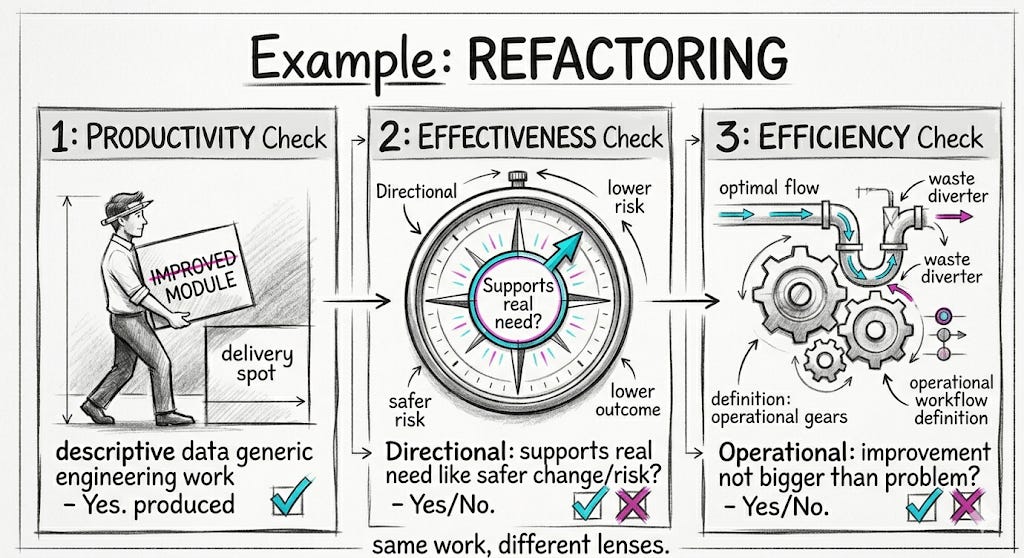
Refactoring is another useful example because it is often misunderstood. A team spends three days improving a messy module. Productivity says engineering work was produced. Effectiveness asks whether the refactoring made an actual upcoming change safer, cheaper, or easier. Efficiency asks whether the improvement was proportional or whether the team expanded the scope beyond the economic need.
This is where the idea of tidying is helpful. Sometimes the best move before changing behavior is not a grand redesign. It is a small structural improvement that lowers the cost of the next change. Rename something. Move a function. Separate two concerns. Clarify a test. Reduce a little confusion before it charges interest. The point is not to beautify the codebase. The point is to improve the economics of the imminent work.
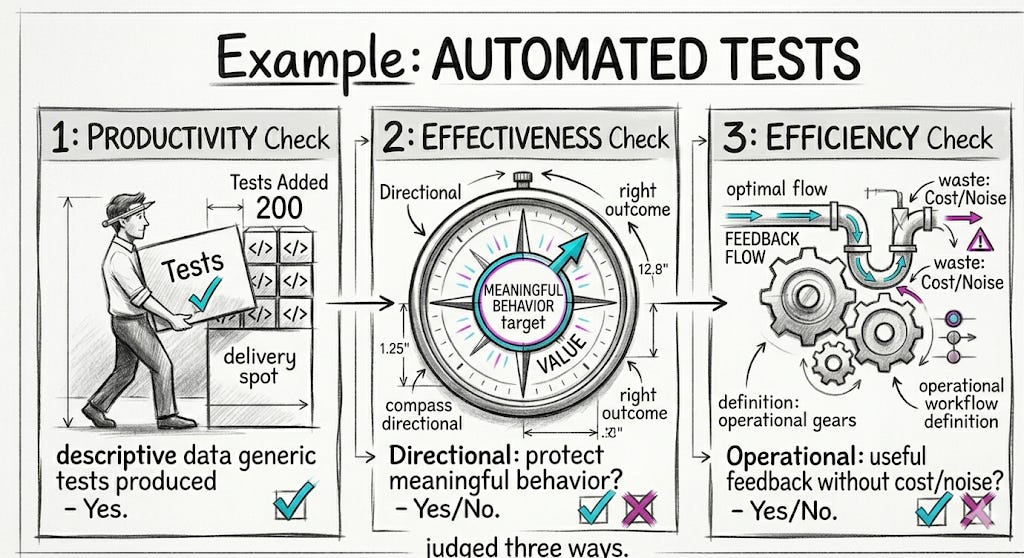
Automated tests also need the three lenses. A team adds 200 tests. Productive? Yes, tests were produced. Effective? Only if they protect meaningful behavior and catch regressions that matter. Efficient? Only if they give useful feedback without excessive runtime, brittleness, maintenance cost, or diagnostic noise.
Test-Driven Development (TDD) should be understood the same way. It is not productive because many tests exist. It is effective when the tests help clarify behavior, discover design, protect intent, and support safe change. It is efficient when the feedback loop stays small enough to help the team learn quickly without turning the process into ceremony.
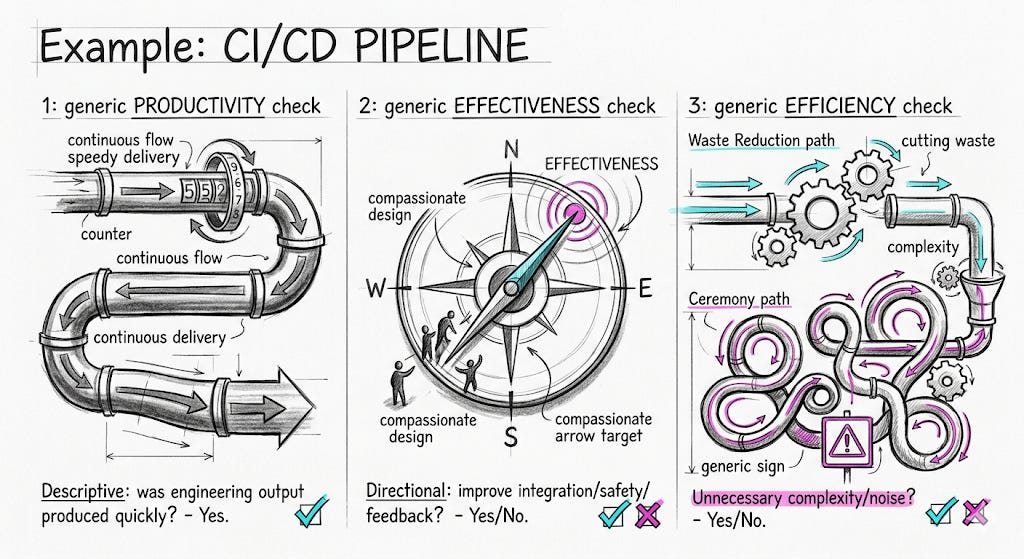
Continuous Integration (CI) and Continuous Delivery (CD) also show the distinction clearly. Building a faster pipeline is productive engineering output. It is effective if it improves integration, release safety, and feedback. It is efficient if it reduces waiting, manual coordination, rework, and release anxiety without creating unnecessary operational machinery.
The same activity can be good or bad depending on the lens. That is why teams need sharper language.
The same work should not be judged with one word. A refactoring can be technically impressive and economically weak. A test suite can be large and ineffective. A pipeline can be fast and still irrelevant if it accelerates the wrong decisions.
How teams should use these words
Teams should use productivity, effectiveness, and efficiency as separate conversation tools. Each word should trigger a different discussion.
When discussing productivity, ask what is being produced. Be precise. Do not say “the team is productive” as a general compliment. Say the team is producing more releasable changes, more validated learning, more operational improvements, more useful tests, or more customer-facing value. The object matters.
When discussing effectiveness, ask why the work matters. What problem should change? Who benefits? What behavior should be different? What risk should go down? What decision will this help us make? What would convince us that the work did not matter?
When discussing efficiency, ask where waste appears. Where do we wait? Where do we rework? Where do we lose context? Where do we hand work across boundaries? Where does cognitive load slow us down? Where does the codebase make valuable change unnecessarily expensive?
Also ask one more uncomfortable question: are we calling this efficient only because everyone looks busy? If the answer is yes, the team is probably measuring occupation, not efficiency. The system exists to move valuable work from need to outcome. If it is full but not moving, it is not healthy.
These questions should not be mixed too early. If someone asks whether a team is productive, do not answer with a velocity number before asking productive at what. If someone asks whether a feature was successful, do not answer only with delivery date. If someone asks whether a process is efficient, do not answer only with speed if the output is low-value.
A good team conversation might sound like this:
Effectiveness: “This feature shipped, but did it reduce the customer problem we expected to reduce?”
Efficiency: “The outcome was good, but why did such a small change take so much coordination?”
Productivity: “Now that we know this type of work matters, how can we increase the flow of similar valuable changes?”
That order changes the culture. It moves the team away from activity worship and toward economic judgment.

This is not a semantic game. It is a practical way to avoid bad management conversations. The team stops using productivity as a moral label and starts using it as one lens among several.
Conclusions
Productivity, effectiveness, and efficiency are simple words, but software makes them easy to confuse.
Productivity means work was produced. Effectiveness means the work achieved the right result. Efficiency means the result was produced with a responsible use of resources. The three ideas are connected, but they are not interchangeable.
This matters because software output does not vanish after delivery. It becomes part of the product’s economic reality. Code must be maintained. Features must be supported. Tests must be trusted. Pipelines must be operated. Decisions must be explained. Complexity must be carried.
That is why producing more is not automatically better. More of the wrong work is inventory. More valuable work through a painful system is fragility. More efficiency in the wrong direction is polished waste.
The best software teams do not use productivity as a moral word. They do not celebrate output before asking whether it mattered. They do not confuse motion with progress, flow with value, or busyness with efficiency.
They separate the questions.
Are we doing the right work?
Are we doing it without unnecessary waste?
Are we producing enough of the work that truly matters?
That is the practical difference. Productivity tells us that the team moved. Effectiveness tells us whether it moved in the right direction. Efficiency tells us whether the movement consumed more than it should.
Strong teams need all three. But they must never pretend they are the same.
References
Cambridge University Press. Productivity. https://dictionary.cambridge.org/dictionary/english/productivity
Cambridge University Press. Effectiveness. https://dictionary.cambridge.org/dictionary/english/effectiveness
Cambridge University Press. Efficiency. https://dictionary.cambridge.org/dictionary/english/efficiency
Valverde Ramos, Emmanuel. Output, Outcome, and Throughput: What Product Teams are really measuring when they say they deliver value. https://emmanuelvalverderamos.substack.com/p/output-outcome-and-throughput-what
Valverde Ramos, Emmanuel. The Resource Utilization Trap: Why Keeping Everyone Busy Can Destroy Real Productivity. https://emmanuelvalverderamos.substack.com/p/the-resource-utilization-trap-why
Forsgren, Nicole; Storey, Margaret-Anne; Maddila, Chandra; Zimmermann, Thomas; Houck, Brian; Butler, Jenna. The SPACE of Developer Productivity. https://queue.acm.org/detail.cfm?id=3454124
Noda, Abi; Storey, Margaret-Anne; Forsgren, Nicole; Greiler, Michaela. DevEx: What Actually Drives Productivity. https://queue.acm.org/detail.cfm?id=3595878
Fowler, Martin. Outcome Over Output. https://martinfowler.com/bliki/OutcomeOverOutput.html
Beck, Kent. Test-Driven Development: By Example. Addison-Wesley, 2003
Beck, Kent. Tidy First?. O’Reilly Media, 2023
Reinertsen, Donald G. The Principles of Product Development Flow. Celeritas Publishing, 2009
Poppendieck, Mary; Poppendieck, Tom. Lean Software Development: An Agile Toolkit. Addison-Wesley, 2003