
The Resource Utilization Trap: Why Keeping Everyone Busy Can Destroy Real Productivity

Modern organizations often praise busyness as if it were the clearest sign of effectiveness. A team with no idle time appears disciplined, efficient, and productive. A room full of people constantly moving, answering, processing, and multitasking seems, at first glance, like a healthy system. Yet the core argument of The Resource Utilization Trap is that this intuition is deeply misleading. The video shows, with unusual simplicity and force, that an obsession with keeping people busy can damage the very thing organizations are supposed to deliver: value flowing to the customer.
Using a ping-pong ball and a small group of people, the speaker builds a deceptively simple demonstration. Each ball represents a customer request or a feature. For the work to be complete, the ball must pass through every member of the team and then reach delivery. This physical model allows the speaker to contrast three different ways of organizing work. The first reveals that low resource utilization can coexist with fast delivery. The second shows how maximizing utilization can collapse the system entirely. The third proposes a leaner alternative: optimize flow first, and only then improve utilization, but without damaging flow.
The strength of the video lies in this central reversal: what many managers treat as waste may actually be the condition that makes delivery possible, while what many managers celebrate as efficiency may actually be the mechanism that stops delivery altogether.
What the demonstration is really about
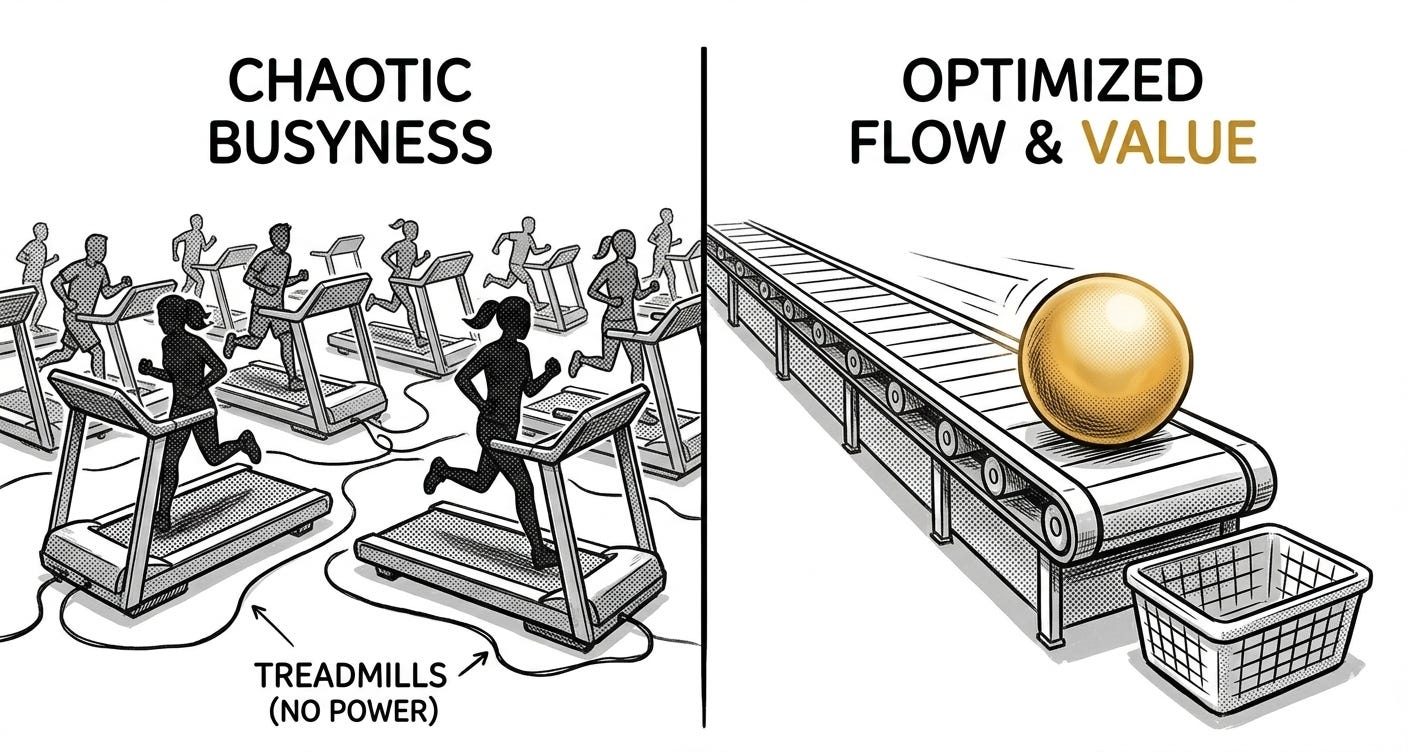
At a superficial level, the video compares three team setups. At a deeper level, it compares two philosophies of management.
The first philosophy assumes that the main problem in an organization is unused capacity. If some people are not constantly occupied, then the system appears inefficient. The obvious solution, from this perspective, is to make sure everyone is always doing something. Activity becomes the proxy for value. Motion becomes the proxy for progress. Full calendars, full queues, and full workloads become signs of managerial success.
The second philosophy starts elsewhere. It asks not whether every individual is always busy, but whether the work itself moves smoothly from request to delivery. In this view, the important unit is not the isolated worker but the whole system. The relevant question is not “Are people occupied?” but “Is the customer receiving the result quickly and reliably?” Instead of measuring individual busyness, this approach measures the movement of value across the entire chain.
The video clearly sides with the second philosophy. Its thesis is not that utilization is irrelevant, nor that idle time is always desirable, but that utilization must be subordinated to flow. Once flow is healthy, utilization can be improved carefully. When utilization becomes the primary target, the system can become busy, congested, and ultimately sterile.
Scenario one: low utilization, fast flow
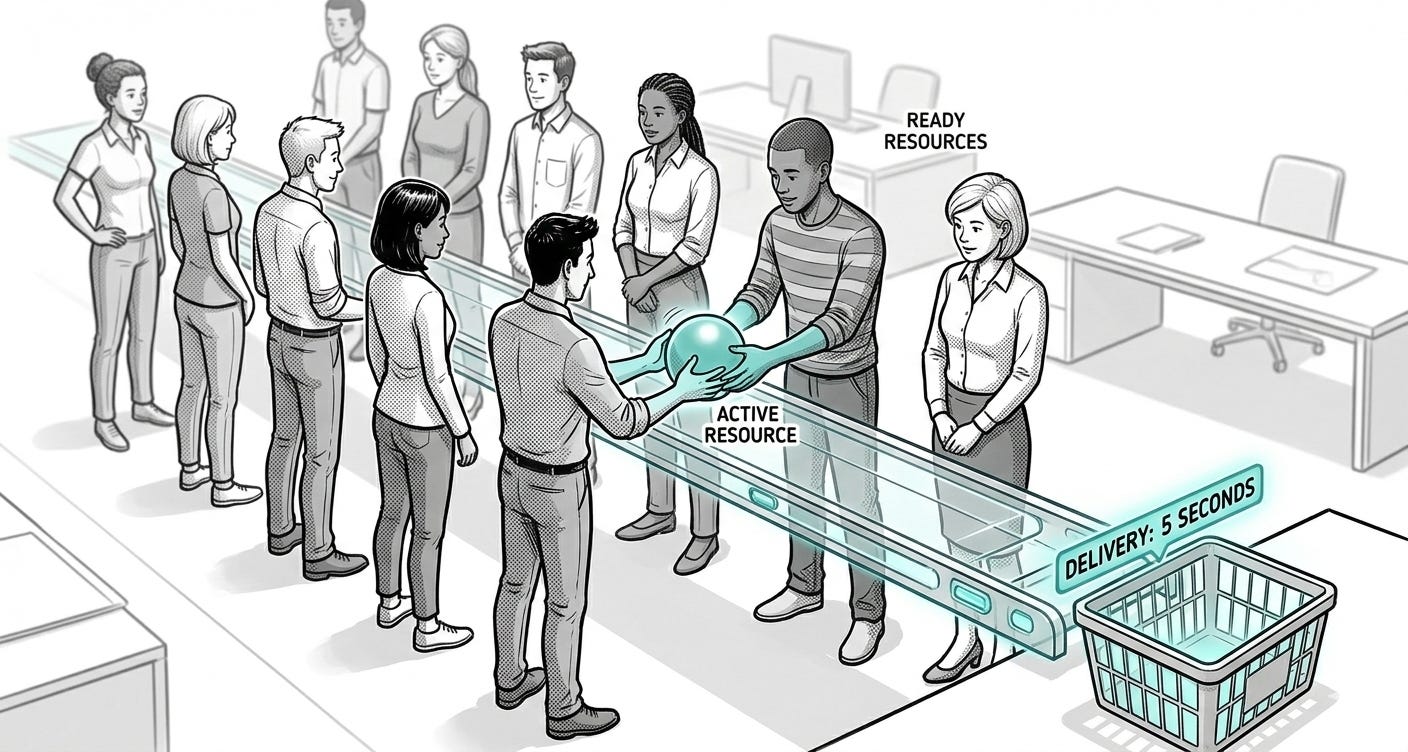
The first scenario is deliberately simple. One ping-pong ball enters the system at a time. The team passes it from hand to hand until it reaches delivery. Because only one ball is moving through the process, only one pair of hands is active at any moment. The rest of the team appears idle.
From the perspective of a manager obsessed with utilization, this looks inefficient. If only one hand out of eight is working at a time, then much of the available labor seems wasted. Yet the important fact is that the ball gets delivered quickly. According to the speaker, the flow time is roughly five seconds. The customer receives the result. The system works.
This first scenario contains the first major lesson of the video: low local utilization can coexist with strong global performance. In other words, parts of the system may appear underused while the system as a whole performs well. That distinction matters because organizations often confuse local efficiency with overall effectiveness. They see waiting and conclude there must be a problem, when in fact the waiting may simply reflect the rhythm required for smooth coordination.
What this scenario reveals is that not all apparent idleness is waste. Sometimes it is slack, and slack is what allows work to move. The people who are not touching the ball in a given second are not necessarily a sign of dysfunction; they are part of a process that is successfully delivering. The system is not optimized to keep every hand busy every instant. It is optimized to complete the job.
This is a subtle but important shift. The value of a team does not lie in the number of simultaneous motions it can exhibit. Its value lies in how effectively it can transform requests into completed outcomes.
The manager’s mistake: confusing visible activity with value
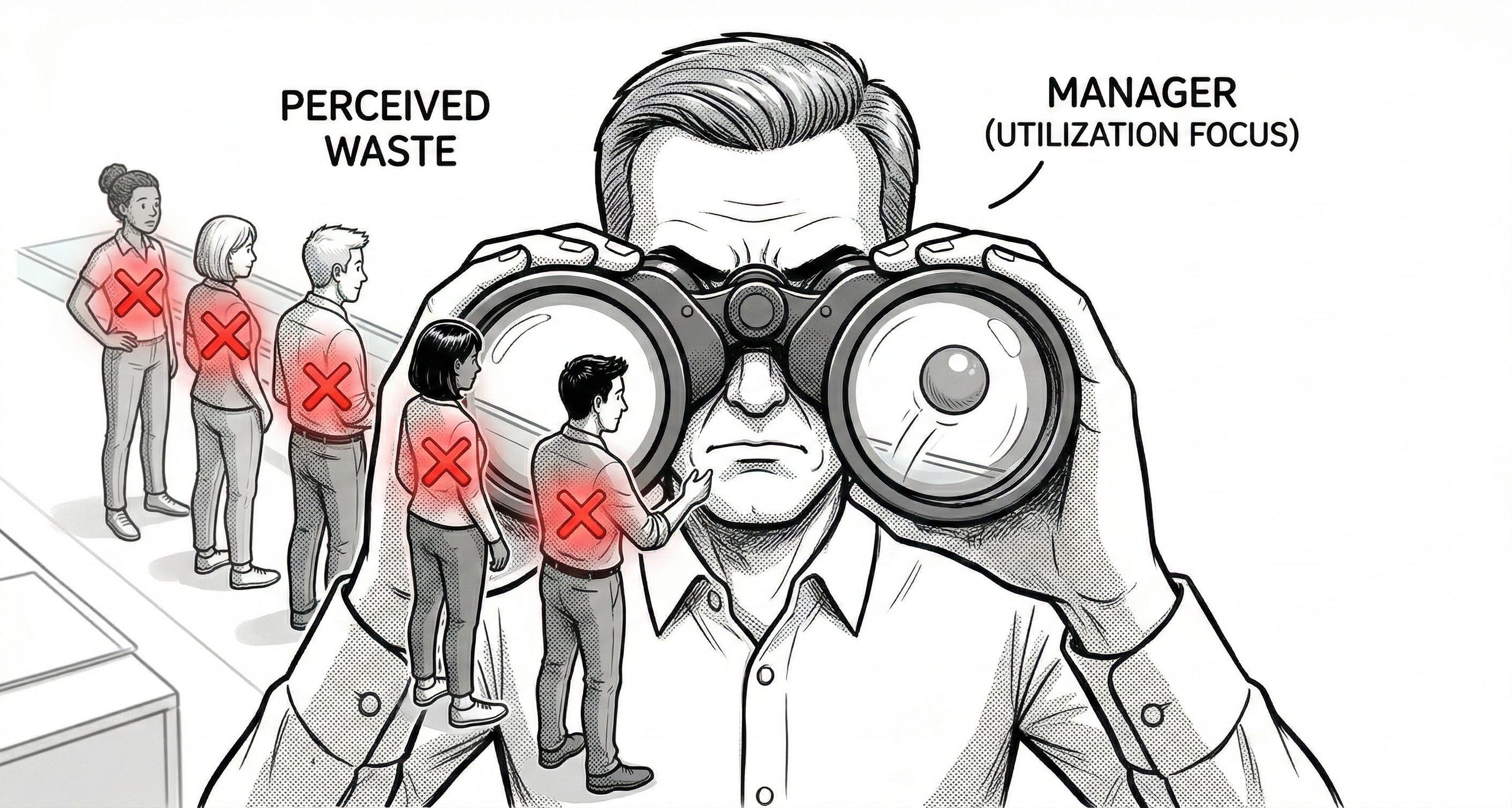
The turning point of the video comes when the manager walks in. He observes several people idle and only one person working. That image triggers a familiar managerial response: this is waste, these resources are being underused, and the system must be fixed.
The mistake is immediate and structural. The manager evaluates the team through a narrow visual snapshot rather than through the system’s actual output. He sees inactivity and assumes failure, even though delivery is fast. He responds to appearances rather than to results. This is the trap.
The video is especially sharp here because it captures a common organizational reflex. Many interventions are triggered not by poor customer outcomes, but by discomfort with visible slack. A quiet employee, an empty queue, or a pause between tasks can provoke anxiety in managers who equate occupancy with value. The result is often a policy designed to eliminate idle time without asking whether that idle time was protecting the system.
In this sense, the utilization trap is not just an operational problem. It is also a perceptual and cultural problem. It depends on a particular way of seeing work. When managers trust what looks busy more than what delivers effectively, they risk optimizing the wrong thing.
Scenario two: maximum utilization, zero delivery
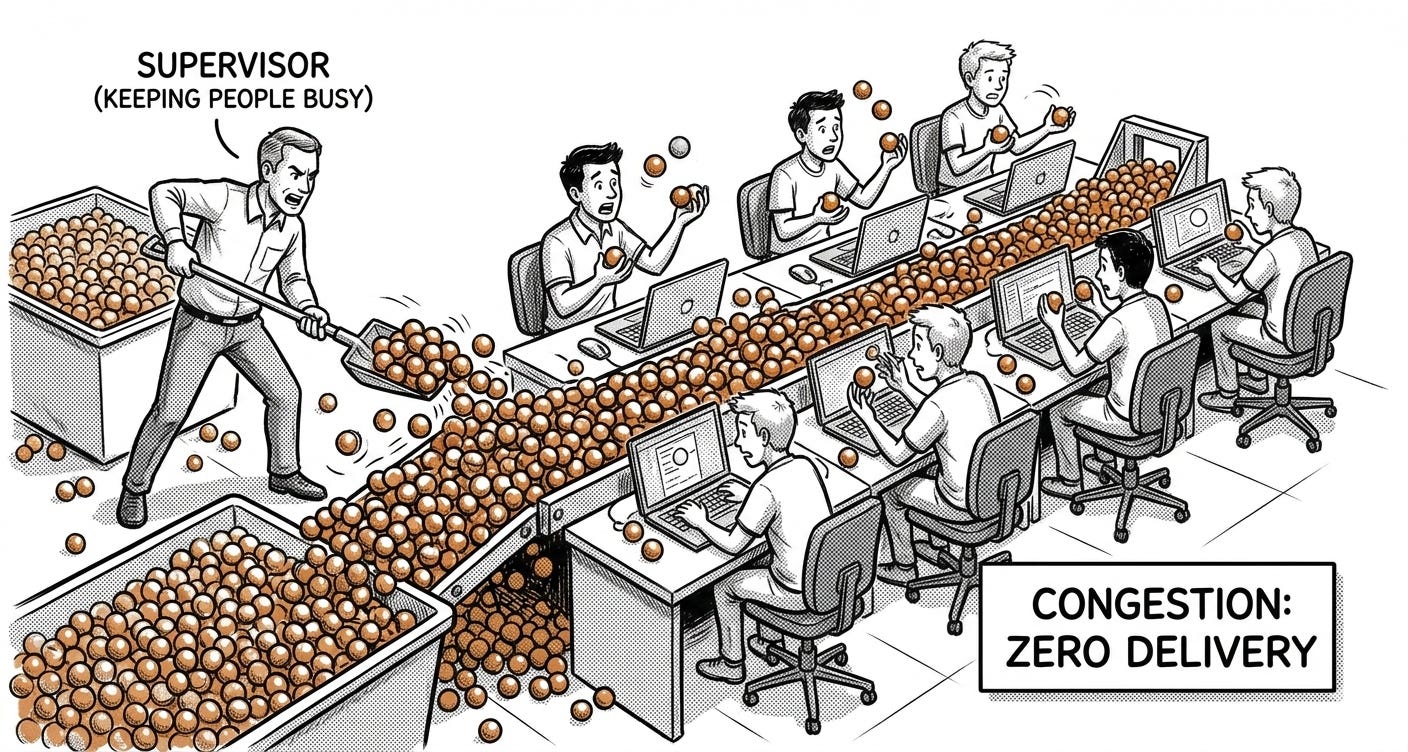
In the second scenario, the manager hires a supervisor whose job is to keep people busy. Work is now pushed continuously into the team. Whenever a hand is available, another ball is placed there. The visual effect is dramatic: everyone is occupied, everyone is handling something, everyone appears fully utilized.
From one angle, this looks like an improvement. The earlier “waste” seems to have disappeared. No one is standing idle. The salaries appear fully justified. The supervisor is successful according to the metric he was hired to improve.
And yet the system has collapsed.
The balls pile up. Work becomes entangled. Nothing reaches delivery. The customer receives nothing. Flow time becomes, in the speaker’s words, effectively infinite. Throughput falls to zero. What looked like a victory in utilization becomes a catastrophe in outcomes.
This is the core paradox of the video: a system can be full of activity and empty of results.
Why does this happen? Because once work is pushed into the system faster than it can move through it, the process stops behaving like a clean sequence and starts behaving like congestion. Every new task competes for attention, space, coordination, and handling. Instead of helping the work move, the extra load traps it. The system loses the very property that made it useful: the ability to convert requests into completed deliveries.
The brilliance of the demonstration lies in how concrete this becomes. The audience does not need abstract theory to understand the problem. They can see the balls accumulating and failing to reach the customer. The point becomes undeniable: keeping every person busy does not mean the organization is productive. It may mean the organization is gridlocked.
Busy people are not the same as a productive system or even an efficient system
One of the strongest lines in the video comes near the end: if you focus on keeping people busy, what you get is a bunch of busy people.
This sentence captures the entire critique. Busyness is not the same as progress. Occupation is not the same as throughput. A manager can generate intense activity without generating delivery. In fact, the second scenario suggests that maximizing visible activity may actively undermine delivery.
This distinction matters because organizations often reward the signals of busyness. They reward overloaded calendars, rapid task switching, long queues, constant handling, and immediate response to whatever appears next. These behaviors can look like commitment and effort. But the video asks a harder question: what happens to the customer?
That question exposes the limits of utilization as a primary metric. If a team is overwhelmed with partially handled work, the customer does not benefit from the fact that everyone is exhausted. The customer benefits only when something is actually completed and delivered. A system that converts effort into delay is not efficient merely because it feels intense from the inside.
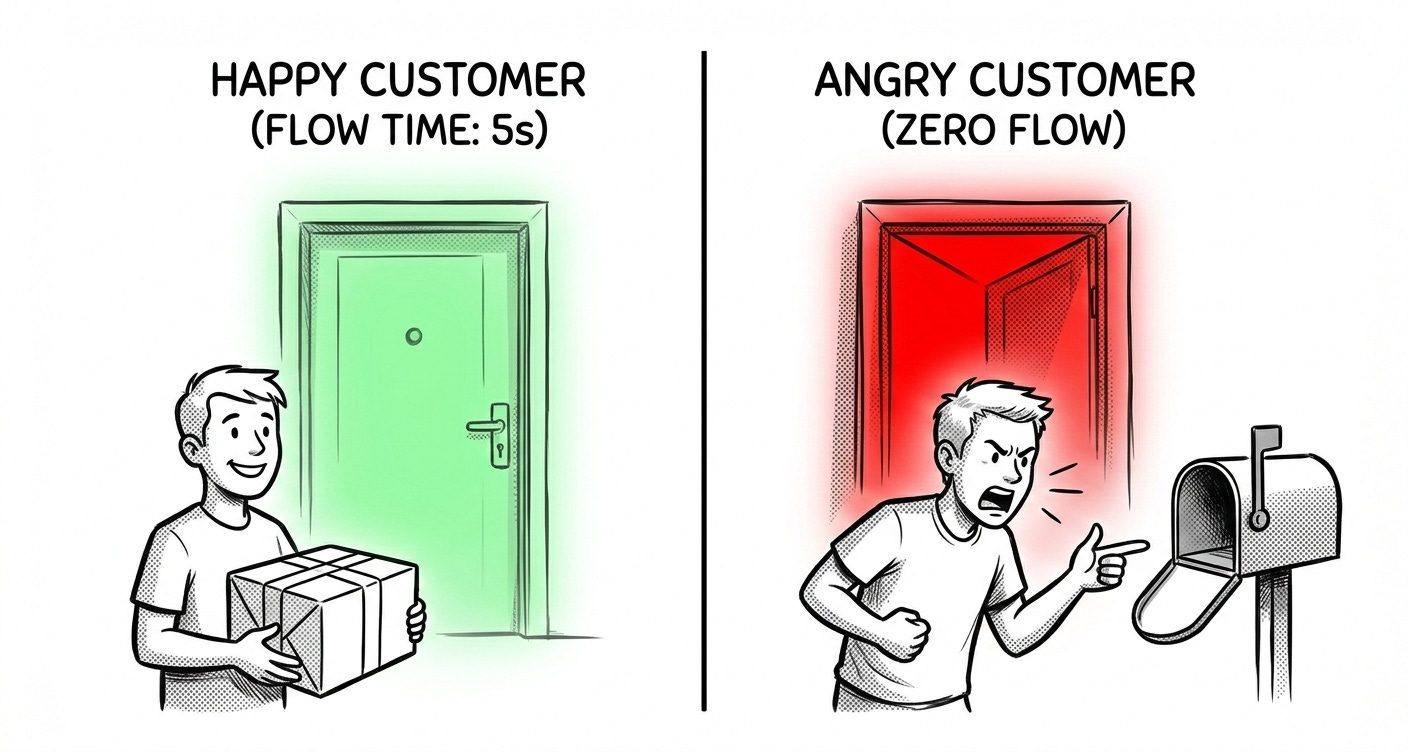
The speaker’s contrast between the happy customer and the angry customer is therefore essential. The first scenario, despite low utilization, creates customer satisfaction because work arrives. The second, despite total utilization, creates frustration because nothing arrives. The moral is clear: the system must be judged from the standpoint of delivered value, not internal busyness.
Push versus pull
The video names the second scenario a form of push. Work is pushed into the system by an external controller. The supervisor decides when more work should enter, based on the desire to keep resources occupied. The team does not regulate intake according to its real capacity. The result is overload.
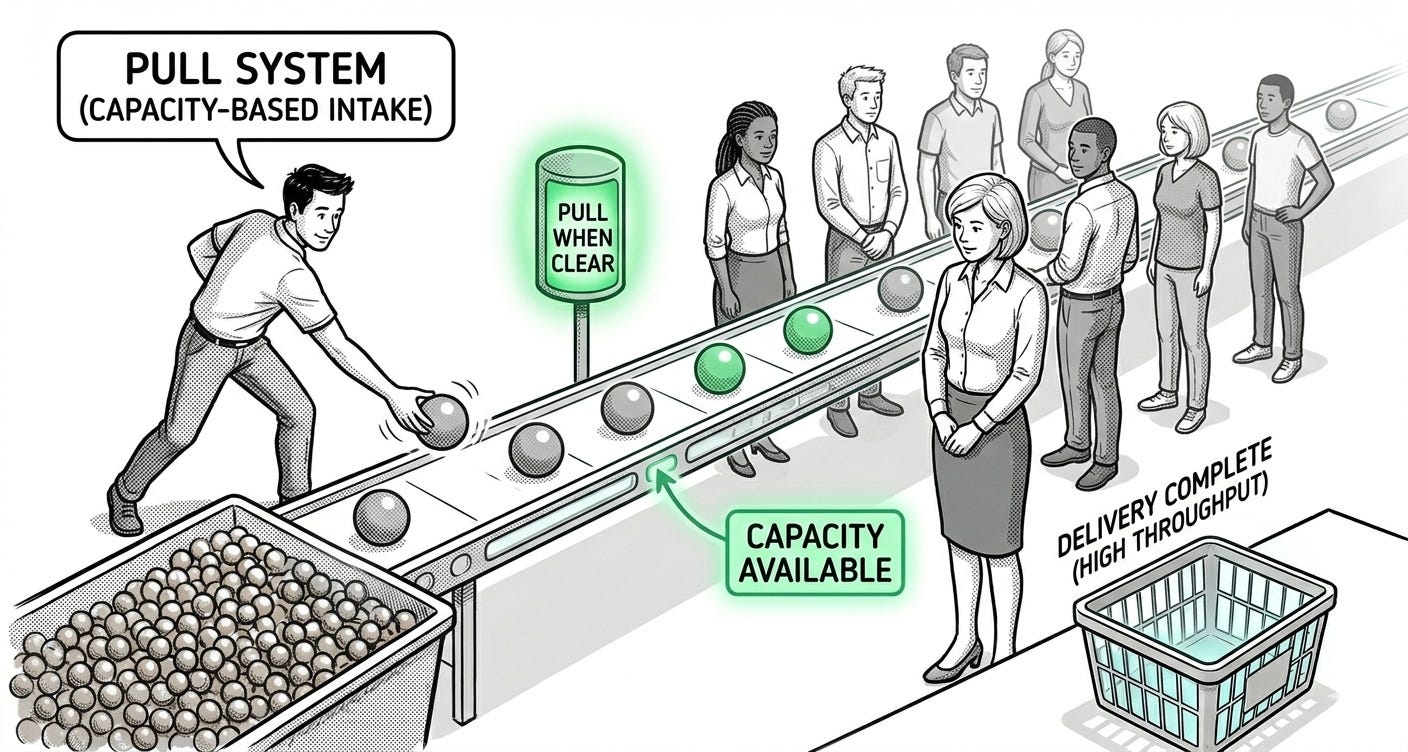
The proposed alternative is pull. Instead of having work forced upon them, the team takes in new work when it has the capacity to handle it. This is not a call for laziness or drift. It is a disciplined way of matching demand to the system’s actual ability to absorb and process work.
That distinction is central. Push begins from the supply of effort: “We have available hands, so let us feed them work.” Pull begins from the condition of the flow: “We will take more work when the system can move it.” Push measures success by how much enters. Pull measures success by what can move through and out.
In the video, pull changes the logic of control. The team, not the supervisor, determines the pace of intake. That change does not reduce performance. On the contrary, it improves it. By respecting capacity, the system avoids congestion. By avoiding congestion, it preserves fast delivery. And by preserving fast delivery, it creates the conditions for greater output over time.
Pull, then, is not merely a technique. It is a philosophy of restraint. It accepts that the health of a system depends not only on what it can do, but also on what it refuses to overload.
Scenario three: better utilization without sacrificing flow
The third scenario is the most important because it avoids a false conclusion. After seeing the disaster of 100% utilization, one might think the lesson is to ignore utilization entirely. The video explicitly rejects that conclusion.
Instead, the speaker argues for sequence: first optimize flow, then improve utilization, but only in ways that do not damage flow.
Under the pull approach, the team keeps the same fast delivery time while increasing the amount delivered in a given period. According to the speaker’s rough numbers, the first scenario produces around 12 balls per minute. The second produces zero. The third raises throughput to around 24 balls per minute while also increasing resource utilization from perhaps 10–15% to around 30%.
These numbers matter because they show that the critique of utilization is not anti-efficiency. The point is not that organizations should ignore capacity. The point is that capacity must be managed systemically. When managed badly, attempts to increase utilization destroy delivery. When managed well, utilization can rise naturally as a consequence of better flow.
This is a far more sophisticated message than a simple “flow good, utilization bad” slogan. The speaker’s actual argument is disciplined and balanced:
first, establish a healthy flow;
second, preserve that flow;
third, improve utilization only within those constraints.
That sequence is what makes the approach lean. It treats flow as primary and utilization as secondary, not because utilization lacks importance, but because it becomes meaningful only inside a functioning system.
The traffic jam analogy
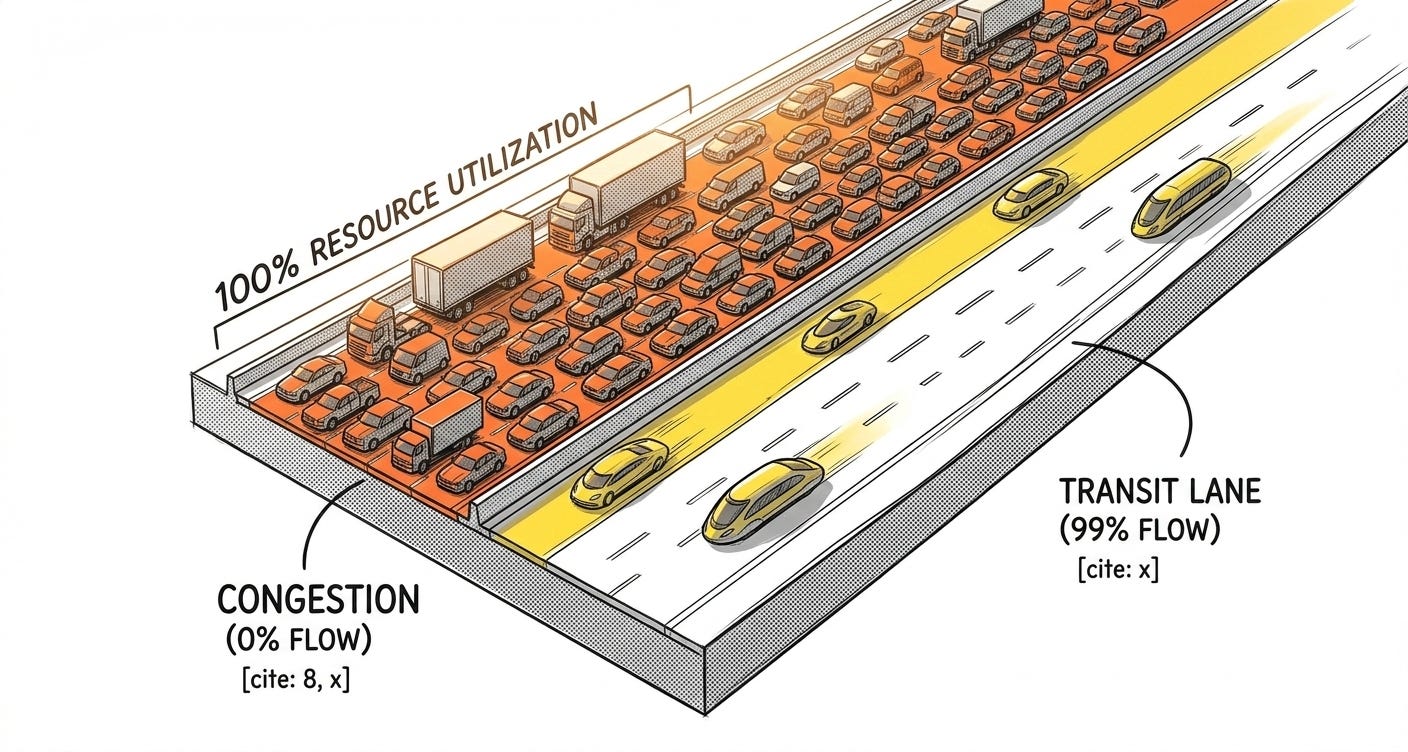
The closing analogy in the video is memorable because it translates the demonstration into everyday experience: 100% resource utilization equals 0% flow, just like a road network at full utilization becomes a traffic jam.
This analogy sharpens the main point by showing that the principle is not limited to office work. Traffic systems behave similarly. A road can seem to be used “efficiently” when every lane is full, but once capacity is saturated, movement slows, then stalls. At that point the system is not productive precisely because it is overused.
The analogy is effective because it reveals the difference between static and dynamic thinking. Static thinking sees a full road and says, “Good, no capacity is being wasted.” Dynamic thinking asks, “Are vehicles moving?” The same applies to organizations. A static manager sees full schedules and says, “Good, everyone is busy.” A dynamic manager asks, “Is work reaching the customer?”
This is perhaps the deepest conceptual contribution of the video. It shifts the frame from occupancy to movement. Systems exist to move something: cars, information, requests, features, decisions, products. When movement is sacrificed in order to maximize occupancy, the system defeats its own purpose.
What the video suggests about management
Although the demonstration is playful, its implications for management are serious.
First, it suggests that managers often create problems by intervening too early and measuring the wrong thing. In the first scenario, the team is already delivering effectively. The manager disrupts that effectiveness because he cannot tolerate visible idle time. His intervention is driven by a metric detached from the customer outcome.
Second, it suggests that managerial control can become counterproductive when it ignores system capacity. The supervisor in the second scenario is not incompetent in the narrow sense. He does exactly what he was asked to do: keep everyone busy. The failure comes from the objective itself. When the wrong target governs behavior, diligent management can make the system worse, not better.
Third, it suggests that good management requires trust in flow rather than obsession with appearances. A team that pulls work based on capacity may look less dramatic than a team drowning in tasks, but it may deliver far more value. This requires a cultural shift. Managers must learn to tolerate some visible slack if that slack protects movement and completion.
Finally, the video implies that organizations should evaluate success through customer delivery, lead time, and throughput, rather than through the local utilization of each person. The system exists to serve an outcome beyond itself. When internal metrics overshadow that purpose, dysfunction follows.
Why this lesson is difficult to accept
The idea that lower utilization can produce better results runs against many organizational instincts. It is difficult to accept for several reasons.
One reason is psychological. Idleness is easy to notice and easy to judge. Flow is harder to see. A manager walking past a room can instantly spot someone not actively handling something. It is much harder, in that same moment, to understand whether the overall process is healthy.
Another reason is symbolic. Busyness signals seriousness. People who are visibly overloaded may be seen as committed, important, or indispensable. By contrast, a smoother and calmer system can be misread as underperformance, even when it is delivering more.
A third reason is structural. Many organizations divide work into functions and then evaluate each function separately. In such environments, each unit is pressured to maximize its own utilization, even if the overall chain suffers. The video challenges that logic by showing that local optimization can destroy system performance.
The lesson is therefore not just technical; it is countercultural. It asks organizations to value completion over activity, movement over saturation, and system outcomes over local appearances.
A more rigorous reading of the three metrics
The video organizes the demonstration around three measures: resource utilization, flow time, and throughput.
These three are not equivalent, and the power of the video comes from showing how they interact.
1. Resource utilization
This refers to how much of the available capacity is actively in use. In the first scenario it is low. In the second it is effectively total. In the third it increases moderately without breaking the system.
The video’s argument is not that utilization is useless, but that it is dangerous when isolated from the other two measures.
2. Flow time
This is the time it takes for a request to move through the system and reach delivery. In the first scenario it is fast. In the second it becomes effectively infinite. In the third it remains fast.
Flow time is what connects the internal process to customer experience. A system with terrible flow time may feel active internally, but it is failing in practical terms.
3. Throughput
This is how much gets delivered over a period of time. In the first scenario it is decent. In the second it drops to zero. In the third it doubles.
Throughput matters because it reveals the cumulative consequence of preserving flow. A system that protects movement not only serves individual requests faster; it often delivers more in total.
Taken together, these three measures support the central conclusion: utilization must not be pursued in a way that damages flow, because damaged flow eventually destroys throughput as well.
The article’s central argument
The most rigorous way to state the argument of The Resource Utilization Trap is this:
A team should not be optimized primarily for constant activity at the individual level, because maximizing local utilization can overload the system, increase congestion, delay delivery, and reduce overall output. The healthier approach is to optimize the flow of work first, then improve utilization only to the extent that flow remains intact. A pull-based way of organizing work supports this balance better than a push-based one.
Everything in the video supports this thesis. The first scenario establishes that low utilization can still produce strong flow. The second proves that high utilization can destroy flow altogether. The third shows that once flow is protected, utilization and throughput can both improve.
That argumentative sequence is what makes the demonstration so persuasive. It does not merely assert a principle; it stages the evidence in a visible progression.
Conclusion: from busyness to delivery
The lasting value of The Resource Utilization Trap lies in the clarity of its warning. Organizations often become trapped because they confuse means with ends. They begin by trying to make better use of people and end by making it harder for work to reach the customer. They celebrate motion while starving delivery. They optimize occupation and undermine output.
The video offers a cleaner discipline: focus on flow first. Ask how quickly and reliably work reaches the customer. Protect that movement. Then, and only then, look for ways to improve utilization without disturbing the system’s ability to deliver.
This is not a romantic defense of inefficiency. It is a more demanding idea of efficiency,one measured not by how full the system looks, but by how well it works.
The final formula, “100% resource utilization equals 0% flow,” is deliberately provocative, but it captures the essential warning. A system can become so full that it stops moving. When that happens, the appearance of efficiency masks the reality of failure.
The deeper lesson is simple and difficult at once: the goal of work is not to keep everyone busy. The goal of work is to get something meaningful done and delivered.