
Subcutaneous Acceptance Tests: Verifying Behavior Just Below the Surface

What Happens After 200 OK?
“Your API returns 201 Created when registering a user… but did the user receive the welcome email?”
A correct HTTP response doesn’t always mean the system behaved correctly. In many cases, the user-facing value comes from side effects — not just response bodies.
Let’s say you run a REST API. When someone registers, the backend must send a personalized welcome email. You can’t observe that behavior through the HTTP response. A black-box test wouldn't catch that failure. Yet verifying it is essential.
That’s where subcutaneous acceptance tests shine.
They let us validate user-facing behaviors from just under the surface of the system — not too deep (like a unit test), not too external (like an end-to-end test), but right at the boundary of behavior.
What Is a Subcutaneous Acceptance Test?
A subcutaneous acceptance test:
Verifies a user-level behavior or acceptance criterion.
Bypasses the transport layer (e.g., HTTP), but not the business logic.
Injects controlled dependencies (e.g., a mock email sender).
Focuses on side effects, not just output responses.
Avoids relying on infrastructure like databases, SMTP servers, or external systems.
“It’s still an acceptance test — it just dives slightly under the skin to get clearer feedback.”
Use Case: Send a Welcome Email After User Registration
✅ Functional Requirement:
“When a user registers, the system must send a personalized welcome email.”
We don’t want to spin up the full application stack. We just want to verify that after registration, the email is sent with the expected content.
The Final Implementation
This example uses:
A User domain object
A RegisterUserUseCase
An EmailSender interface
A subcutaneous test that verifies behavior using Mockito
Domain Model
public class User {
    private final String email;
    private final String username;

    public User(String email, String username) {
        this.email = email;
        this.username = username;
    }

    public String email() { return email; }
    public String username() { return username; }
}
Email DTO
public record EmailMessage(String to, String subject, String body) {}EmailSender Interface
public interface EmailSender {
    void send(EmailMessage message);
}
UserRepository Interface
public interface UserRepository {
    void save(User user);
}
RegisterUserController
public class RegisterUserController {

    private final EmailSender emailSender;

    public RegisterUserController(EmailSender emailSender) {
        this.emailSender = emailSender;
    }

    public int registerUser(String email, String username) {
        UserRepository userRepository = user -> {}; // No-op for simplicity
        RegisterUserUseCase useCase = new RegisterUserUseCase(userRepository, emailSender);
        useCase.register(new User(email, username));
        return 200;
    }
}
Subcutaneous Acceptance Test
Here’s how we verify that the business behavior actually happened:
import org.junit.jupiter.api.Test;
import org.mockito.ArgumentCaptor;
import static org.junit.jupiter.api.Assertions.*;
import static org.mockito.Mockito.*;

public class RegisterUserSubcutaneousTest {

    @Test
    void should_send_personalized_welcome_email_after_user_registration() {
        EmailSender emailSender = mock(EmailSender.class);
        RegisterUserController controller = new RegisterUserController(emailSender);

        int response = controller.registerUser("emma@example.com", "emma");

        assertEquals(200, response);

        ArgumentCaptor<EmailMessage> captor = ArgumentCaptor.forClass(EmailMessage.class);
        verify(emailSender).send(captor.capture());

        EmailMessage message = captor.getValue();
        assertAll(
            () -> assertEquals("emma@example.com", message.to()),
            () -> assertEquals("Welcome emma!", message.subject()),
            () -> assertEquals("Thanks for signing up, emma.", message.body())
        );
    }
}
✅ The test validates one acceptance criterion: the email was sent, with the right data.
Why Not a Black Box Test?
With a black-box API test, you'd miss what really matters, the email behavior.
HTTP response codes don’t reflect all business logic
Subcutaneous tests avoid awkward side effects, like calling a 3º party system that you do not control.
They’re faster and more precise at validating side effects
When to Use Subcutaneous Tests
Use them when:
Behavior cannot be verified via the public interface
You want fast feedback and clear behavioral assertions
You want to verify what the system does, not just what it returns
Avoid when:
You must test UI or end-to-end performance
Side effects are the interface (e.g., webhook endpoints)
Benefits Recap
✅ Clean feedback on user-level behavior
✅ Avoids unnecessary infrastructure setup
✅ Easy to write and execute
✅ Great fit for hexagonal and Clean Architecture
✅ Ideal for communication-based testing
Visual Overview
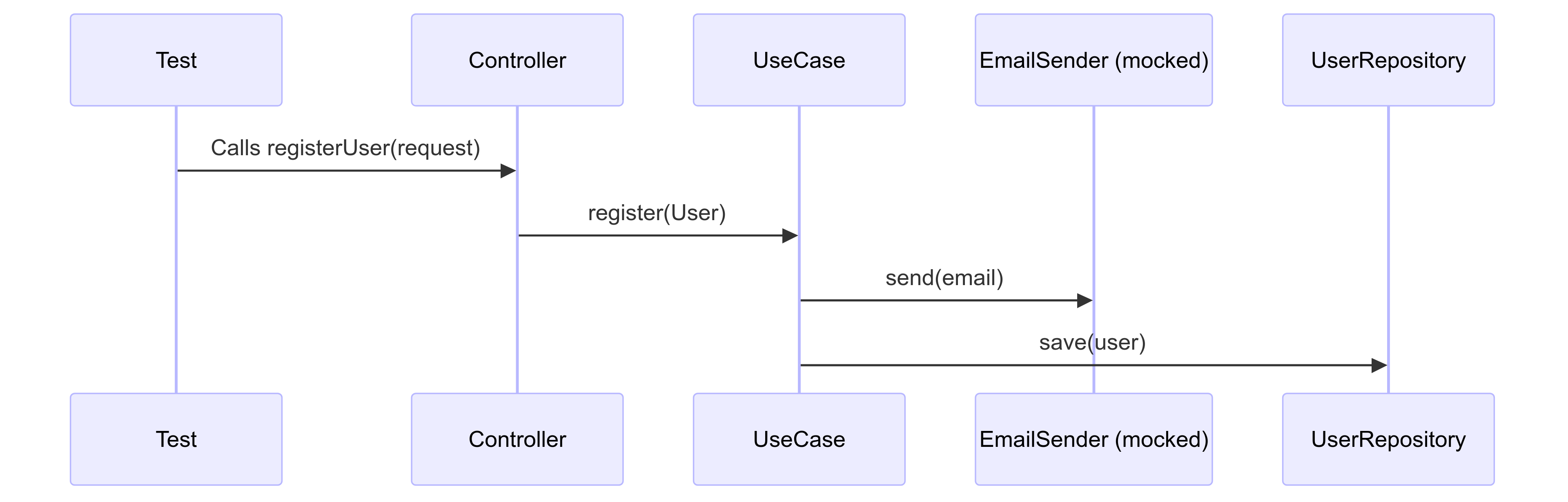
We stay close to real behavior, but control dependencies for precise verification.
Conclusion: Clarity, Behavior, Confidence
“A subcutaneous acceptance test checks if your system kept its promise — not just if it returned the right code.”
Don’t settle for superficial test coverage. If your software makes promises (like “users will get a welcome email”), you should test that promise — clearly, directly, and effectively.
Subcutaneous acceptance tests help you do just that.
No overkill. No overreach. Just behavioral confidence, done right.
References
Fowler, Martin. SubcutaneousTest. https://martinfowler.com/bliki/SubcutaneousTest.html
Farley, Dave. How to Write Acceptance Tests.
Adzic, Gojko. Specification by Example.
Beck, Kent. Test-Driven Development: By Example.
Freeman, Steve. Pryce, Nat. Growing Object-Oriented Software, Guided by Tests.
Meszaros, Gerard. xUnit Test Patterns.
Crispin, Lisa. Gregory, Janet. Agile Testing.
North, Dan. Introducing BDD. https://dannorth.net/introducing-bdd/
Smart, John Ferguson. BDD in Action.